Just a quick note that I've posted a review of Modern Man by E.J. Lonergan over at The Strangelands, so check it out over there. (The Strangelands is the website of author Ray Weeks, whose books The Adventures of Portly Boy and Eat Me I've previously reviewed.)
Showing posts with label Lulu. Show all posts
Showing posts with label Lulu. Show all posts
Sunday, February 07, 2010
Review Posted Elsewhere: Modern Man by E.J. Lonergan
Just a quick note that I've posted a review of Modern Man by E.J. Lonergan over at The Strangelands, so check it out over there. (The Strangelands is the website of author Ray Weeks, whose books The Adventures of Portly Boy and Eat Me I've previously reviewed.)


Saturday, November 21, 2009
REVIEW: Eat Me by Ray Weeks
 In a prior review, I discussed how much I enjoyed Ray Weeks' superhero parody/homage The Adventures of Portly Boy. I now turn to Weeks' altogether more serious, but equally enjoyable, Eat Me: A Zombie Story Collection (Lulu paperback or pdf download).
Eat Me is formally a series of disconnected short stories, each set in a progressively further future and populated by completely different characters. However, the collection as a whole forms a novelistic arc of the history of a zombie armageddon, from present times through the end of our current civilization and into to what follows.
And even though the book itself is fairly short (at 170 pages), the tale is epic. Each story stands very well on its own; by giving himself the luxury to progress through time and different characters' lives, Weeks frees himself to explore some very interesting new ideas (and to bypass entirely those boring, undying cliches that seem to infest zombie fiction, the evil biker gang and the evil military).1 But even beyond the effectiveness of the individual stories, the whole creates something even greater: an apocalyptic panorama that is variably exciting, humorous, sad, and uplifting.
If Eat Me has any (minor) flaw, it is that all of the characters have similar voices. The collection is professionally written and edited, and I enjoy Weeks' casual yet muscular writing style. But Weeks especially excels at a snarky, sarcastic tone (as is apparent from The Adventures of Portly Boy and Weeks' blog, The Strangelands). In Eat Me, no matter the supposed background of the character narrating a particular story or the overall tone of that piece, one can sense that persona lurking close by.
But this is a minor quibble. Even if all the characters sound a bit similar, they are also similarly captivating, and I can unreservedly recommend Eat Me to anyone who is looking for zombie fiction that is epic in scope, imagination, and the range of emotion it inspires (if not in page count).
BONUS RECOMMENDATION
In addition to his book writing, Weeks occasionally reviews other authors' novels on his blog. He has been especially fulsome in his praise for the first two novels in Rhiannon Frater's As the World Dies zombie trilogy, The First Days and Fighting to Survive (click titles for Weeks' reviews; click here to purchase The First Days, Fighting to Survive or the third book, Siege, as ebooks from Smashwords, or here for paperback or Kindle versions from Amazon). I agree with the core of Weeks' review, which is that Frater's writing is very strong, particularly her characterization:
Her characters are interesting, and the story trucks along at a good speed. There's gore and death and all that other fun stuff you expect from a zombie story, but there's also an actual story, so it isn't just a bunch of people you don't care about getting chased by dead things.
Nonetheless, I have a bit more difficulty with the plotting in the trilogy than Weeks apparently does. I fully enjoyed The First Days, which seemed wholly fresh and avoided the "evil gang / military" cliche discussed above. However, even though the writing remains involving, the crux of the action in the second novel (as foreshadowed in the first) involves an evil gang. I haven't read the third novel yet, but am concerned that an evil military may be involved.
I very well may be wrong (which is the problem with discussing books one hasn't even read yet). And even if I'm right, Frater's writing is strong enough that I can add my recommendation to Weeks' for anyone whose personal prejudices about how zombie novels should be plotted do not coincide with mine.
---
1 Seriously, why do so many zombie novels and films feel compelled to revisit the tired old trope of the eeeevil biker gang or soldiers, whose main pastime is invariably sexual subjugation? I'm not necessarily arguing that such evildoers wouldn't arise in the 'real' world after the collapse of civilization. But aren't other people bored of reading about it? As Ken Begg recently observed over on Jabootu.net when reviewing the movie The Infestation:
The film does at least a couple of things very right. First, there’s no human villain to waste time on. I remember how glad I was to hear that Piranha 3-D was going that route, and this proves that I was on the right track in this regard. Amazingly, the filmmakers apparently [recognized] there was enough juice in a giant bug apocalypse to drive the narrative, and that eeeevil military or corporate scientists were not required.
I couldn't agree more. Isn't there enough juice in a zombie apocalypse to drive the narrative, such that eeeevil biker gangs or soldiers are not required?
Sunday, November 15, 2009
REVIEW: The Fence Mender by Anghus Houvouras
 The Fence Mender is an enjoyable if not revolutionary addition to the zombie genre. Decades ago, mankind faced an apocalyptic infestation of parasites that transformed people into murderous, cannibalistic automatons (i.e., zombies). Now, a small number of urban enclaves are the last bastions of civilization, each protected by a metal-mesh protective fence that keeps the zombies out. (Why no one ever built a concrete wall is never explored.)
Our lonely, misunderstood hero is responsible for keeping the fence in good repair. However important his job may be, his heart yearns for something more, something beyond his narrowly circumscribed world. Specifically, he yearns for a life with with a woman in a neighboring fence-city with whom he has maintained a wistful radio relationship. When the woman's town is overrun by zombies, the fence mender decides to abandon his post and make the seemingly impossible journey to try to rescue her.
It is no surprise that first time novelist Anghus Houvouras is a film critic and filmmaker, as The Fence Mender (Lulu paperback; Kindle ebook) has a decidedly cinematic flavor. And notwithstanding the novel's pastoral cover, sedate start and melancholy official blurb, that flavor ultimately is action extravaganza. Our initially nebbishy, contemplative hero slides easily into improbable action man mode for the final third of the story as he literally pulls out the heavy artillery and faces down hordes of zombies while participating in several mighty big explosions. And even as Houvouras entertains us with large-scale violence and chaos, he also focuses the attention down on our leading players, inviting us (as action movies often do) to care more about the fate of two people than about the dozens of other minor characters who flesh out the action (or the countless multitudes who have already died pitiably in the background).
But even if The Fence Member is a novelized screenplay at heart, it is fun and effective. The action sequences excite, and the novel does succeed, in a broad-brush way, in creating empathy for our hero, as well as tension about who will ultimately survive. These accomplishments are genuine and significant.
However, the novel needs a thorough proofread, as typos and continuity slips abound. Moreover, although the novel is already a relatively short 200 or so pages, more could easily be cut. The first 10% of the book is completely extraneous, including an entire pre-credit sequence -- excuse me, prologue -- that provides some needless background on the origins of the fence-city system. Indeed, our hero is not introduced until chapter three. Everything before that is expendable, as are the occasional subsequent passages where the POV shifts away from our main characters to some military and political folks who deliver some clunky exposition. The Fence Mender is a good read, but it could be even better in a revised, re-edited, refocused edition.
BONUS RECOMMENDATION
Carrie Ryan's The Forest of Hands and Teeth (Delacorte Books for Young Readers; Amazon) also involves a zombie menace that has overrun the world but is kept at bay from the few remaining pockets of humanity by a chain-link fence. However, except for that similarity, Ryan's world is very different than the one portrayed in The Fence Mender. Civilization has deteriorated far more; the origin of the fences is far more mysterious. Most importantly, there is far more teenage angst and moping. Once the heroic fence mender in Houvouras' tale decides to save his lady love, mindless action (which I enjoy tremendously) takes center stage. By contrast, although The Forest of Hands and Teeth contains a perfectly fair amount of zombie mayhem, it is overshadowed by teenage whining, self-doubt, self-discovery, self-loathing, and general self-involvement. Some people may prefer that. And Ryan's writing certainly is fine, the atmosphere of dread and mystery is strong, and the novel maintained my interest enough that I read through to the end. Moreover, I didn't notice any typos. But for all that, I enjoyed The Fence Mender more.
Sunday, May 11, 2008
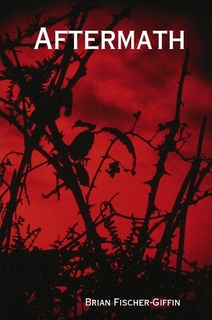
REVIEW: Aftermath by Brian Fischer-Giffin
 PLOT
A plague has descended in the wake of a passing comet. Most people are dead. Biker Talon Willis is one survivor. Teenaged Tahnee Goss is another.
But living through the plague is one thing.
Living through the aftermath is quite another.
MY TAKE
If you're looking for a basic, bread-and-butter post-apocalyptic tale, Aftermath will likely satisfy. Fischer-Giffin's writing (which alternates between Talon and Tahnee's diary entries to tell the story) is straightforward, engaging and, of critical importance, brisk. Fischer-Giffin keeps the action moving forward at all times, which is exactly the right approach. Most readers of Aftermath likely will already be familiar with the conventions of the post-apocalyptic genre, and Fischer-Giffin hews closely to them in his episodic tale, up to and including the expected climactic battle between the forces trying to rebuild civilization and the eeevil marauders out only to rape and pillage. Accordingly, because we readers know what to expect, there is no need for Aftermath to linger; rather, it is a locomotive, allowing us to enjoy the ever-changing scenery, even if we are already familiar with the journey as a whole. (And, to be fair, there are some welcome, if mild, deviations from what I predicted when I started the novel: biker Talon does not turn out to have quite the heart of gold one might expect (tarnished bronze is more like it), and teenaged Tahnee, even making allowances for the fact that her family and friends are dead and she's living in a post-apocalyptic nightmare, is, amusingly, really quite insane.)
AVAILABILITY
Aftermath is available from Lulu as a $3.75 pdf download (or a $19.50 paperback). Fischer-Giffin also maintains a MySpace page.
BONUS RECOMMENDATION
Aftermath may not be particularly innovative, but sometimes telling a simple tale in a straightforward manner can be more fun for the audience than would be a more unconventional narrative. For example, I enjoyed the short film Postapocalyptic Sandpit for most of its increasingly outlandish running time. But as it entered its more surreal final moments, it lost me entirely, both in terms of literal narrative and emotional response. By contrast, I can enjoy the new-wavish song "Among the Ruins", a straightforward soundtrack to the loneliness of life in the post-apocalyptic world by long-dissolved punk 'n' roll band the Vee Gates (which bills its music as "post-apocalyptic rock"), without reservation.
Tuesday, April 29, 2008
REVIEW: Summerworld by Serdar Yegulalp
 PLOT
It all starts when psychoanalyst Dr. Hirofumi receives an odd note from Masuda, a former patient, inviting Hirofumi to join Mausuda at a country spa. Odd because Masuda committed suicide three years ago.
And that is just the beginning. Hirofumi soon discovers that the veil of perceived reality has been ripped away altogether, and the rules of the old world no longer apply. What is left behind is called Summerworld. It is a realm where people can be who they want to be. Or at least who they view themselves as being. And Summerworld is changing to meet the expectations of those who inhabit it.
But Hirofumi also learns that straddling the line between your past and your hopes and dreams for the future can be tricky. Not everyone can walk that tightrope and make the transition. Especially when forces are gathering to push Summerworld entirely off balance.
MY TAKE
It is really quite impressive how Summerworld pulls together its seemingly divergent stylistic threads into such a satisfying tapestry.
Summerworld is deeply philosophical. Author Serdar Yegulalp presents a thoughtful meditation on the fine balancing act between clinging to the past and losing oneself in dreams of change. Yet, philosophy aside, Summerworld also contains several wonderfully involving action scenes. And happily, Yegulalp knows that a battle is all the more exciting when the sides are evenly matched. It never feels like the villains are too strong, and thus that the heroes can only prevail through luck or authorial caprice. Rather, even at the final, spectacular confrontation, there is a pronounced sense of balance, and that only heightens the tension.
Summerworld is in many ways a fantasy novel. It takes place in the world of magic, warriors and dreams that emerges after our modern society has been pushed aside. But the novel also is grounded in reality. On a literal level, remnants of our present world linger even after Summerworld rises. More importantly, many of the characters carry the baggage of their prior lives. As a result, Summerworld's characters feel completely genuine and of this world, notwithstanding their larger-than-life fantasy trappings. On the outside they may be heroes, but on the inside they're people.
Summerworld has a powerfully epic quality. Hirofumi's journey to understand the nature of the threat that surrounds him is fully developed and feels complete. Yet Summerworld also tells smaller, intimate stories about the relationships, both old and new, that are forged in this new world. And these small, understated character moments are just as compelling as the overall saga.
Summerworld's final apparent contradiction is that, despite the scope of Yegulalp's achievement, the novel is in fact only 284 pages long. So even if you're pressed for time, there is absolutely no reason not to go and pick up this fine novel.
AVAILABILITY
Summerworld is available from Lulu (as are Yegulalp's other novels) as a $14.99 paperback. Yegulalp also maintains a personal website that includes, among other information, news about various past and upcoming projects.
BONUS RECOMMENDATION
The members of Mystechs recently announced that they are putting the band on hiatus while they head to Hollywood to pursue their moviemaking dreams. It is hard to argue with their logic: after ten albums in as many years with limited commercial success, they feel it is time, at least for a while, to focus on other creative endeavors.
Happily, while moving forward, the band members appear also to value their years in the music trenches. As one member comments in a recent blog entry, "I don’t think I’m being full of shit when I say I wouldn’t trade the Mystechs experience to play in 98% of the bands that get lots of hype or sell lots of records." Nor have they foreclosed the possibility of returning to music some day, even as they focus for the moment on their filmmaking.
In the meantime, the band leaves behind a substantial musical legacy recorded in several different pop and rock styles. The earlier albums tend to be a bit hit or miss, although they include some songs I truly love, like the bouncy, clever political dance pop of "Shouldn't Be Dancing" from Showtime at the Apocalypse (2002). But the more recent albums, each of which is a witty pastiche of a particular genre, are much more consistent: Dixie Inferno (2008) is a riotous take on southern rock, Hot Tub O' Blood (2007) is an equally warped take on heavy metal, and Escape from Planet Love (2006), my personal favorite, takes on '70s disco and funk.
Straddling the early- and late-period albums is 2005's Warriors and Warlocks, a (very) loose concept album about using fantasy to escape the drudgeries of the workaday world. Any horror movie aficionado will appreciate "Zombie Mountain," an exhilarating three-and-a-half minute zombie flick with a hillbilly twang. But the highlight is title track "Warriors and Warlocks," about a suburbanite's dream to leave behind her "white-bread paradise" for a more exciting world where her inner elven princess can fight dragons, devils and demons. Not a novel theme, certainly, but one that the Mystechs handle with charm, sympathy, and a nicely propulsive chorus.
More information about purchasing all of the Mystechs' albums (including iTunes links for the more recent releases) can be found at their website.
Sunday, April 13, 2008
REVIEW: Timely Persuasion by Jacob LaCivita
 PLOT
I don't usually do this, but today I am simply going to quote Timely Persuasion's official blurb (see here or here) as my plot description (trust me, I have my reasons):
What did Kurt Cobain, Jimi Hendrix, and my sister have in common? They were all my friends, and they died. Timely Persuasion follows an anonymous music critic on a quest to save his sister from the relationship that ended her life. After a chance encounter at a bowling alley leaves him with the ability to travel in time, our hero uses his musical knowledge to “blink” through the years attempting to keep the couple apart by any means necessary. But is her husband Nelson really to blame? Along the way he launches a new folk rock star, accidentally restructures his family tree, and crosses paths with the likes of Huey Lewis, Bob Dylan, Paul McCartney, and Billy Joel. Reliving past events through the eyes of his younger selves, he soon finds that correlation and causation are not always what they seem. This story of death, life, love, and rock 'n’ roll defies genre conventions while paying tribute to the classic time travel tales that came before it.
MY TAKE
Timely Persuasion reflects a peculiar phenomenon that is common in mass-market releases, where hired gun publicists write the back-cover copy, but is less usual in the do-it-yourself POD world. To be blunt, Timely Persuasion's misleading plot blurb makes a fun novel sound absolutely cheesy. Based on the official description (with its promise that the hero is "friends" with Cobain and Hendrix and also "crosses paths" with assorted other rock luminaries), I suspected that Timely Persuasion would be a series of trite wish-fulfillment trysts between a thinly-veiled author-stand-in protagonist and his musical idols, which in the end would add up to little more than a collection of fanboy fantasies.
Happily, Timely Persuasion absolutely does not go down this road. The conceit of the novel is that time travel is possible to any date that resonates strongly in the traveler's memory. For our time-traveling protagonist, those days often have rock music significance. However, our hero does not actually interact with his music idols. Rather, although his remembrances of important music dates are the springboard from which he launches his travels through time, they really are just the backdrop to his real mission: to prevent his sister's suicide.
And so Timely Persuasion ends up being much more enjoyable than the the above description had led me to expect. The writing is professional and polished, and author Jacob LaCivita does an admirable job keeping the complex mechanics of his recursive plot clear for the reader. At times his exposition is a bit too blunt, as one character will spell-out for another exactly what is going on. But that's really no different than Doc Brown drawing on the blackboard to explain the intricacies of time travel for Marty in Back to the Future Part II. And Timely Persuasion is clearly a movie at heart. Indeed, on April 1, LaCivita joked on his blog that Timely Persuasion had already been snatched up as a movie with an all-star cast. Although LaCivita was kidding, Timely Persuasion absolutely has "summer blockbuster" written all over it.
Of course, as I've mentioned before, big-studio summer films are known for being fun and clever, but also for ultimately being disposable. Indeed, Timely Persuasion raises a number of intriguing issues that it never fully explores. For example, the narrator at one point funnels hit songs from the future to a singer from the past, in order to advance the past performer's career. He expressly recognizes that in doing so, he is effectively depriving the future (original) artists of writing (or profiting from) their own songs. Maybe it's just me, but I find the implications of that fascinating (not just in the chicken-and-the-egg paradox sense; what I really find interesting is the ethical and artistic issues). And so perhaps it is unfair of me to criticize LaCivita for staying focused on the tale he wanted to tell, rather than going off on a tangent that I was interested in. But it is very frustrating to have interesting themes explicitly raised, only to be quickly brushed off to the side.
Nonetheless, high-concept films and novels definitely have their place, and Timely Persuasion fits solidly in that category. I enjoyed it for its substantial cleverness, breezy style, and pleasingly convoluted plot, which had just enough pathos at the end to give the journey some substance. If I'm a bit dissatisfied with Timely Persuasion, it is only because I would have liked more focus on some of the side-issues. But even as the novel stands, it is great for beach reading, and there's absolutely nothing wrong with that.
However, I would still change that back jacket copy.
AVAILABILITY
Timely Persuasion is available as a $16.00 paperback or a $5.00 pdf download through Lulu. Alternately, you can read the novel for free through an online reader at the Timely Persuasion website, where further background information is also available. Even more information is available at the novel's blog, including an ongoing series of chapter-by-chapter author's notes and comments. Finally, random bits and pieces thematically linked to the book are available at Local Blog Done Good (the name has significance once you've read the book). LaCivita clearly takes marketing his book seriously (for which he should equally seriously be commended).
BONUS RECOMMENDATION
In the spirit of Timely Persuasion, I offer up a music track that always pulls me back in time (not from an independent artist, alas -- this dates back to a time before I discovered that wonderful world): Ratt's "Round and Round" (the link is to the DRM-free Amazon music store). Back in 1983, I thought this was a great song; to be honest, I still do. And, should a movie adaptation ever be made, I think "Round and Round" would be the perfect choice to play over the credits. Anyone, or at least anyone from my generation, would instantly understand the concept that pop music can transcend time and create a tunnel straight back through the decades (has it really been 25 years?). And while I know that the song isn't actually about time travel, I don't think anyone really knows the lyrics beyond the perfectly apropos "Round and round/what goes around comes around/I'll tell you why" anyhow. So cum on feel the noize! (oh wait, that was someone else.)
Wednesday, April 02, 2008
REVIEWS: Strange Sleuths: Three Novels about Peculiar P.I.s
Mickey Spillane's Mike Hammer. Raymond Chandler's Philip Marlowe. Robert Parker's Spenser. Hard-boiled detective thrillers are a venerable and beloved staple of American literature. To be honest, I have never been a tremendous fan of the traditional crime novel. But that is not an issue with any of the three novels below, each of which takes the detective novel is a wholly unconventional direction.
 Wildclown Hijacked by G. Wells Taylor is the most straightforward of the bunch, which is really saying something given that the novel chronicles the adventures of a spirit, in the quasi-post-apocalyptic world of the Change (in which the dead have arisen to resume their old lives), who possesses the body of an alcoholic private investigator who, in turn, wears clownface greasepaint in order to hide his face -- and thus his past -- from his own gaze.
Wildclown Hijacked is the sequel to When Graveyards Yawn, a novel I absolutely adore, and, perhaps unfairly, the new installment suffers a little bit in comparison. The problem is not with the writing; Taylor's prose continues to be absolutely top-notch. Wildclown's gritty, down-to-earth narration perfectly counterpoints the nightmarish phantasmagoria of life after the Change, and Taylor captures the mystery, violence and horror of this new world beautifully.
Rather, it is the plot that falters. To anyone already familiar with Wildclown's world (or even who has just read the above paragraphs), the title of this novel explicitly gives away exactly what is going to happen. Moreover, beyond the titular event, not much else occurs. As a result, there is very little surprise as events unfold. The details of the journey are everything. The strength of Taylor's writing is such that it is nearly enough. But in the end, Wildclown Hijacked was a little bit too predictable, even with its completely over-the-top finale.
(Wildclown Hijacked is available as a $9.94 paperback when ordered from Lulu through a special link at the book's web page -- go to wildclown.com and click on the Wildclown Hijacked cover there.)
 On the surface, Robert Barry Kaplan's The Useless Detective appears much more conventional. Our narrator, a small time P.I. so lackadaisical that he doesn't even get a name, has managed to rouse himself to attend a twenty-year college reunion party at an isolated country estate. Before the night is over, one party goer has been murdered and a sudden storm has cut off all contact with the outside world. No one has any faith that our narrator can solve the crime before the killer strikes again. This, it would seem, would be the perfect opportunity for our hapless "hero" to prove his worth.
But we humans don't always rise to meet the opportunities presented to us. Sometimes, when given the chance to shine, we just stay in our ruts. And so it is with our useless detective, who, in fulfillment of his classmates' expectations, utterly fails to rise to the challenge. And so The Useless Detective proceeds like the novelization of a nonexistent Luis Buñuel film, as ennui conquers all and the partygoers resign themselves to day after day of ever more stagnant food, sex, and ultimate slaughter by the unknown killer.
So if The Useless Detective is just a big existential joke, the question becomes whether it at least is a good joke. On the positive side, Kaplan is a polished writer, and the humor, while bone dry, is very real. But once the narrative settles down into its endless cycle of dreary days and nights, I found myself waiting in vain through for something new to happen. Which, of course, is exactly how I'm supposed to feel. I genuinely respect that effect on an intellectual level. In the final analyis, however, this is a novel that is easy to admire but harder to really enjoy. And I wonder whether that's not fine with Kaplan.
(The Useless Detective is available as a $15.95 paperback from iUniverse, Barnes and Noble or Amazon. Kaplan's homepage is here, and he also writes a drolly amusing blog.)
 Chuck Rosenthal's The Heart of Mars is the most out-there of the three novels, both in terms of setting and style. It is four hundred years after mankind was rescued from ecological disaster by benevolent extraterrestrials. Much has changed. There are few pure humans left. There are no machines -- everything is biological, alive. And there is no more writing, or storytelling. It's just not how things are done.
The Heart of Mars is poetic, almost psychedelic. The loose plot, involving half-human Marl's investigation into the hijacking to Mars of a ship full of fish, is only there to give the wispiest of structure to an elliptical journey that involves all manner of strange places and even stranger creatures with still stranger dispositions. The novel is a bit like an Alice in Wonderland in space, except that Marl, unlike Alice, is an intrinsic part of the strange world he inhabits.
In the end, the plot essentially falls away. As Marl gets closer to solving the mystery, the mystery itself becomes less and less relevant, until all that remains is the importance of telling the story. The Heart of Mars may ultimately be too oblique for readers looking for a straight-forward narrative, and, to be honest, I'm not sure I understand it all. But the sustained otherness of the journey is enthralling.
(The Heart of Mars is available in hardcover from Hollyridge Press, Barnes and Noble, Amazon, and other online retailers for $23.95.)
Thursday, March 27, 2008
FreeBooks #10: The Adventures of Portly Boy by Ray Weeks
 Howard McKay isn't really a superhero. He doesn't have any superpowers. In fact, he's a fat alcoholic, who only dresses up in a fluorescent yellow body suit (complete with pink running shorts and boots) because of an unfortunate incident in which he mooned a judge during a drunken romp through the park. As his punishment, the vindictive judge sentenced Howard to an even more unfortunate community service sentence: to patrol the city streets as a citizen watchdog, while dressed in the rather unique aforementioned ensemble.
Moreover, The Adventures of Portly Boy isn't really a novel. Rather, it is a compilation of the first 37 installments (of a total of 69) of a meandering serial narrative that author Ray Weeks posted on the Strangelands website between March 2004 and January 2007 (to go directly to the Portly Boy part of the website, click here). Because Chapter 37 ends at something of a natural (if abrupt) breaking point, Weeks evidently decided to make those chapters available as a free, convenient pdf download from Lulu (and also as a $16.67 paperback, for those who want a more corporeal embodiment of Portly Boy's adventures).
So, for many reasons, Portly Boy is not really a "superhero novel." It is, however, absolutely hilarious. Weeks has a light touch and a genuine gift for situational humor. Howard is an appealing schlub protagonist, and the supporting cast of cut-rate sidekicks and not-so-super villains are appropriately eccentric and amusing. Howard's adventures are consistently fun and, amazingly enough given the glib nature of the entire enterprise, manage to be genuinely tense and exciting at times.
To be sure, the serial nature of Portly Boy's origins, where the original episodes were stretched over a period of nearly three years, takes its toll. Certain jokes are repeated over and over. Nor is there more than the barest whiff of an ongoing plot. Yet none of that undercuts Portly Boy's essential good humor or entertainment value, and I look forward to reading the remaining uncollected adventures (nearly as extensive as the adventures collected in this book) available at the Portly Boy website.
Wednesday, March 19, 2008
FreeBooks #9: Playing for Keeps by Mur Lafferty
 Laura "Keepsie" Branson is in the Third Wave of people born with superpowers: anyone who tries to steal from her gets frozen in place. A few years ago, her power was judged inadequate, and her application to train with the First and Second Wavers at the Seventh City hero Academy rejected. So now Keepsie quietly runs her bar, catering to her minor-league peers. Until she suddenly finds herself at the center of an epic battle between the mightiest heroes and villains of Seventh City, and Keepsie and her friends discover that it is up to them to save the day -- if they can figure out whose side they're really on.
Mur Lafferty's Playing for Keeps is an intriguing but imperfect effort. Lafferty is a clearly a talented writer, and her colloquial style, appealing common-folk (if superpowered) protagonists and skill with action scenes go a long way towards holding the reader's interest. The story, however, does not feel fully developed. The novel is paced a little oddly, with Keepsie and her friends doing a lot of running about that doesn't seem to advance the plot. The motivations of both the "heroes" and "villains" that Keepsie must confront are at times unclear, and their characterizations feel similarly inconsistent. Nonetheless, Playing for Keeps shows tremendous promise both in its writing and its basic premise, and, given the near-cliffhanger nature of the book's conclusion, we will hopefully see more, better-realized adventures of Keepsie and her crew.
Playing for Keeps is available in several different formats, including as a free download (or a $16.99 paperback) from Lulu or as a free audiobook from PodioBooks. Check out the very thorough Playing for Keeps website for other options and extras; Lafferty also maintains a general website here.
Sunday, March 16, 2008
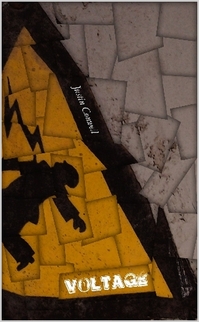
REVIEW: Voltage by Justin Conwell
 PLOT
After attempting suicide, Eric had his self-destructive thoughts blasted out of his head through Electro-Convulsive Therapy. Unfortunately, the therapy also stole his memory of what drove him to suicide in the first place. Even worse, it tore away the creative part of Eric's brain, leaving the former painter without the inspiration to do much more than work as a clerk at the local discount store.
Now a year has passed, and Eric's daily routine is upended when the latest load of donations includes a box filled with ashes and labeled "Harold." Pressed into a road trip to bring Harold's remains back home, Eric finds himself forced to confront both his current life and the past that got him there.
MY TAKE
Over a year ago, I wrote a brief review of Saints Visible by "Justin Gil." I described the novel as a "charming, folksy tale" with considerable "laid back charms," although I found the resolution to be "rather abrupt" and "too easy."
I have been told that Voltage, attributed to a "Justin Conwell," is in fact the same author's second novel. Based on the evidence of the two books, I certainly believe it. Voltage demonstrates the same strengths as Saints Visible: a clear, inviting writing style that immediately draws the reader in. Voltage, however, is a considerably greater triumph, as it marries those strengths to a much more mature and involving story.
With its themes of suicide and long-buried memories, the novel may sound exceedingly glum or melodramatic. And indeed, as one might expect, Eric's buried memories do conceal a tragic story that ultimately impact his present as much as his past. However, Voltage is not a melodrama. Rather, Voltage is a tragedy, in the most positive (if not quite Grecian) sense of that word.
Like any good tragic hero, Eric is both deeply flawed -- indeed, infuriating at times -- but also deeply, recognizably human. Conwell draws us into Eric's tale slowly; although dark rumblings can be heard from the start, the early part of the book is fairly relaxed, and even whimsical. But as the story progresses, we grow to care about Eric and his traveling companions (including romantic interests both actual and potential). When Eric's failings and history inexorably surface, there is nothing flashy or over-the-top about the results; everything in Voltage feels real, and plausible. And this quiet power makes Eric's journey all the more affecting.
Indeed, by the end of the novel Eric and his friends have all learned, in one way or another, that you cannot run away from your past. This is, of course, an ancient literary theme, dating back (at least) to the aforementioned classical Greek tragedies. Yet Voltage distinguishes itself through compelling characters that make its exploration of this well-worn trope feel fresh, powerful, and, ultimately, heartrending. Saints Visible was worthwhile as a cute "feel good" book; Voltage, by contrast, is a genuine work of art.
AVAILABILITY
Voltage is available from Lulu here as either a $0.50 download or an $11.99 paperback. Saints Visible is also still available from Lulu, either as a free download or an $8.56 paperback. The author does not appear to have a website; nor am I aware of any other books he may have written, whether as Justin Gil, Justin Conwell, or some other pen-name.
BONUS RECOMMENDATION
The Sheds have made all four of their folksy rural rock albums available for free download, and I strongly recommend that you take them up on their generosity. Each is strong, but the most recent two -- The Sheds Quit Smoking and You've Got A Light -- are especially stunning. The Sheds sing about the small issues of day-to-day living, and, appropriately enough, their songs encompass the gentle humor, quiet yearning, and upbeat joys of everyday life, while also maintaining a consistent and intense melodiousness. These guys should not be missed.
Monday, May 21, 2007
REVIEW: Noah, Penny by David Skinner
 PLOT
Thirteen year old Penny knows that she is not beautiful. But she also knows that she loves Noah, and only wants him to love her back.
Unfortunately, Noah is awkward and unreadable. Does he feel the same way? They've been friends for years, but this is new terrain.
And the sudden appearance of Fyfe, an ancient elfin creature who's interested mainly in spying on the affairs of humans, is not making Penny's life any easier.
MY TAKE
David Skinner's Noah, Penny is a contemplative, touching novella that, though brief, has a lot to say about how we relate to each other.
I first discovered Skinner over a decade ago, when I was wowed by his The Wrecker (Simon & Schuster 1995). That novel explores questions of good, evil and free will in a manner that, if infinitely more restrained in its imagery than Anthony Burgess' A Clockwork Orange, is no less effective for its subtlety. Whereas The Wrecker can be seen as a rumination on hate and violence, Noah, Penny, by contrast, is a charming meditation of first love. Although both novels are formally works for the Young Adult market, both offer tremendous rewards for the adult reader as well.
Quiet and a bit melancholy, Noah, Penny doesn't rely upon a formal plot. Rather, it explores Penny's situation -- and, ultimately, the nature of love and acceptance -- through a series of generally understated vignettes that follow her halting, uncertain relationship with Noah. Skinner demonstrates a deep, sympathetic understanding that matters of the heart are, ultimately, beyond rational explanation. Penny's story is sad and sweet and real in all the right places. And far from being a jarring intrusion in this otherwise naturalistic tale, the age-old Fyfe instead adds a perfect touch of magical realism, ultimately teaching that the questions Penny faces are not new, but are, indeed, eternal.
AVAILABILITY
Noah, Penny is available as a paperback from Lulu, as are several other of Skinner's self-published books. (The Wrecker is available used on Amazon.) Skinner's website is located here.
BONUS RECOMMENDATION
The animated zombie movie City of Rott is not quiet or subtle. It is the extraordinarily violent tale of an old man seeking to survive -- and to find new shoes -- in a post-apocalyptic world populated primarily by the undead (or, more specifically, dead corpses controlled by alien space-worm-parasites). The violence is graphic and never-ending, if somewhat charming in its cheerful excessiveness.
I suspect that the audiences for City of Rott and Noah, Penny overlap very little. Moreover, Noah, Penny is far more successful and involving than the oft-monotonous City of Rott. Nonetheless, the two works are similar in at least two respects. Both focus primarily on mood and individual moments rather than a detailed plot. And both end on a note of grace that, each in its own way, celebrates the human spirit.
And as a special added bonus recommendation, check out this panel from the increasingly popular xkcd webcomic.
Wednesday, February 21, 2007
Review: Rexroi by Steve Sommers

PLOT
Poor Gary "Little Kid Guy" Gates. He's short, so no one in his frat respects him. His girlfriend is withholding her charms, forcing Gary to sneak around on the side. And Gary's fraternity brothers insist on humoring Alex, a local short-order cook who proclaims that he's the "King of the World" (and that Gary is his "General Monkey Dance"), even though anyone can plainly see that Alex is just a fat oaf.
Now things are getting even worse. Gary is experiencing blackouts and disturbing dreams, not to mention being blackmailed after an indiscreet fling with one of the nurse/stylists at the local blood bank/hair salon. Alex is becoming more and more popular at the frat. Soon Gary finds himself caught between mysterious forces in an epic battle to determine the fate of the world.
It can only end with exploding cows.
MY TAKE
There is no reason to assume that Steve Sommers was a self-important twerp in college. After all, this is fiction. From the other goings-on in the novel, I doubt that this is a reality-based roman à clef. But I have to give credit: Gary Gates is an all too believable obnoxious frat boy protagonist.
Happily, the results are consistently entertaining. Gary may be insufferable, but his egocentric narration perfectly complements the bizarre scenario. On the one hand, we never care much about Gary as a person. He often causes his own problems, and at times crosses the line from obnoxious to outright loathsome. But on the other, his tart recital lends the proper bitterness to a tale that otherwise would deflate under the weight of its own essential silliness. Indeed, reading Rexroi is a bit like watching an inebriated frat boy perform a monkey dance on a ledge: a bit uncomfortable for the audience, but also quite amusing if you're in the right mood, and, perhaps against your better judgment, impossible to turn away from.
AVAILABILITY
Rexroi is available through Lulu as a pdf download ($1.81) or a paperback ($11.95). Steve Sommers appears to have had a number of websites over the years, including here (a blog about Sommers' various Lulu books) and here (a site about Sommers' first novel, Breakfast with the Antichrist). However, I am unclear as to whether either of these (or some other site) is still active.
BONUS RECOMMENDATION
Los Angeles-based Channel 101 and its New York offshoot Channel 102 present monthly five minute DIY "television episodes" that are submitted by members of the general public and voted on by fans at monthly live screenings. Shows that score in the top five are given the honor of returning the following month; below that cutoff, the show is cancelled. All shows are archived on the respective websites and freely available for perpetual viewing pleasure.
One of my favorite Channel 102 series (on which its producers voluntarily pulled the plug) is Shutterbugs, a hilarious series about two self-important jackasses who run a talent agency for child stars. Check it out, along with the rest of the oft-outstanding lineup (Channel 101's Time Belt is particularly great).
Wednesday, February 14, 2007
FreeBooks #2: Memories of Home by Derek M. Koch

In honor of Valentine's Day, I present Memories of Home by Derek M. Koch (available for free download on Lulu). After growing up together, Max and Lisa have only been dating for a few hours. Unfortunately, they're now trapped by a sinister (if ill-defined) force in the Jefferson Theatre, an old-time movie house where Max once accidentally killed a man. As if this first date weren't already bad enough, Max's previous girlfriend also shows up, apparently possessed by the same nebulous evil and out for blood.
I know it's unfair of me to criticize Memories of Home. The novel was written in only 30 days as part of National Novel Writing Month (or NaNoWriMo). Koch readily admits in his introduction that the novel needs further work, which is why he is giving it away for free.
And Koch is not being modest when he says that Memories of Home is still rough. He does a credible job of setting up an aura of dread and mystery. However, once Max's friend (under the influence of the aforementioned evil) pulls a gun to force Max and Lisa to accompany him to the Jefferson, the story starts spinning in hamster-wheel circles. Various characters sporadically get possessed by the something, and then come to their senses. A variety of menacing, if somewhat haphazard, nasties chase our heroes around. Everyone runs several laps around the Jefferson, but no one ever arrives anywhere. Then the evil and the novel both just stop (when, I suspect, the 30 day NaNoWriMo window ended). I don't require everything to be explained in a horror novel -- indeed, I often think a novel works better when substantial mystery remains -- but here, the menace is not so much mysterious as arbitrary.
What's amazing -- and at times frustrating -- is how clearly Koch's talent shines through despite these problems. Even when the novel starts treading water, it does it with panache. The writing remains polished and effective, and many individual scenes are truly unnerving. The novel may have significant structural problems, but I nonetheless enjoyed reading it for the power of the discrete moments.
Which, ultimately, prompted this FreeBooks entry. I want to encourage Koch to keep up his efforts. I want him know that someone (someone he doesn't even know) is reading is work, and that I truly look forward to his next book. Because even horror authors need love on Valentine's Day (although I'm sure Koch will understand -- and, indeed, be grateful -- if I leave the heavy lifting in this regard to his wife).
For more information on Koch, check out his website and blog.
Wednesday, February 07, 2007
FreeBooks #1: Saints Visible by Justin Gil
 Saints Visible by Justin Gil (available for free download on Lulu) is a charming, folksy tale about what happens when a fundamentalist preacher arrives in small, easy-going Brahmton and his influence begins to grow. The town librarian's narration is funny and relaxed, and even the rather abrupt, too-easy resolution is tonally consistent with the novel's laid-back charms. All in all, Saints Visible is a quick, satisfying read for a low-key evening.
Unfortunately, Gil appears neither to have his own website nor to have written anything else to date.
Monday, February 05, 2007
REVIEW: Fake Girls by Matthew Sloan
PLOT
Molloy might pass as a real private investigator if he had a bit more class. But as things stand he's a scavenger. People who are desperate somehow find him. For a fee, he helps.
Nada Klone is the internet's hottest adult personality. And she's missing. Two powerful opposing factions have each commanded Molloy to find her, or else. Now Molloy is trapped in a nightmare, caught between these mysterious forces and his own equally murky passions in his quest for a woman who is as elusive as the internet itself.
MY TAKE
Fake Girls does many things well. It is wonderfully written: the sleaze that permeates Molloy's life oozes off the page, and Molloy is a likable narrator whose sardonic sense of humor enlivens the story without undercutting the situation's menace. The mystery, although more philosophic than literal, is compelling. And, unusually for so metaphysical a story, the ending is terrific, with a satisfying conclusion that neatly both encompasses and builds upon all that has gone before.
Fake Girls has many interesting points to make about the nature of reality and personality in the digital age. However, the most intriguing -- and touching -- part of the novel is its exploration of who and why we love (kind of like a grindhouse version of Enola's Wedding). Molloy has a genuinely tender relationship with a transsexual prostitute, and then a more lustful affair with a woman he meets during his investigation. A husband loves the wife who cheats on him constantly. A man searches for his online lover, with no prejudice about who that may turn out to be. In all of these instances, Fake Girls quietly but firmly imparts its message: love is where we find it, and we simply have to adapt.
AVAILABILITY
Fake Girls is presented by the Afterhuman Press and published through Lulu. Until recently, it was available for purchase as a paperback or a pdf ebook directly from Lulu; however, the Lulu link appears not to be working at the moment. Hopefully it will revive shortly; until then, the novel is available as a Lulu-printed paperback on Amazon ($15.96). Matthew Sloan appears not to have his own website.
BONUS RECOMMENDATION
Spray is a great synth duo who produce outrageously fun pop music. Not only do their songs consistently impel me to dance (and I am rather hard to get in motion), but, surprisingly for the genre, the lyrics are witty and just as worthwhile as the music. Spray has just released a splendid new album, Children of a Laser God. Among the highlights are several songs about the illusory and mysterious nature of relationships, including "He Came With The Frame," about the merits of treating the guy pictured in a new photo frame's marketing insert as your significant other; and "Pretend Girlfriend," about the advantages of paying someone to pretend to be your partner in front of your friends.
Children of a Laser God is available for download on eMusic, as is Spray's equally outstanding first album, Living in Neon. (If you can tolerate buying music encumbered with DRM, both albums are also available on iTunes). Living in Neon is also presently available as a physical CD from CDBaby; hopefully Children of a Laser God will soon be as well.
Monday, January 08, 2007
REVIEW: Continuity Slip by Till Noever
PLOT
Ray Shannon is an ordinary guy, driving home on an ordinary day.
But then Ray saves a stranger named Alyssa Weaver from certain death, pulling her from her burning car in the midst of a massive freeway pile-up.
Now Ray's entire world has changed. Literally.
The highway on-ramp that used to have one lane now has two. Ray's colleagues at work have been replaced by new faces. Ray's wife suddenly hates him.
Even worse, the cops suspect Ray of murder.
And worst of all, the evidence points to one conclusion: they're right.
Now Ray and Alyssa need to work together to figure out what's going on, before everything they know slips away forever.
MY TAKE
Continuity Slip reads like an archetypal summer Hollywood movie. The writing is clean and polished. The narrative pushes forward relentlessly. Parallel universes are always fun, and the philosophical conceit at the heart of the novel -- the way little changes in experience might cumulatively impact a person's entire nature -- is intriguing. Ray and Alyssa are a likable couple, and their romance is not only part of the plot, but cleverly explains the plot (and yes, I know that sounds rather cryptic).
However, also like many big-studio films, Continuity Slip feels a little shallow. Although the novel raises interesting concepts, it never explores them. All of the recondite discussion about alternate realities ends up serving only as background color for a standard murder mystery that could just as well have happened in this reality. The two plot threads never significantly mesh. Indeed, once the mystery is resolved, the shifting realities thread is wrapped-up very quickly, almost as an afterthought.
I look forward to reading more works by Till Noever. He plainly is very talented, and Continuity Slip is nothing if not professionally written. The strength of Noever's style and the affability of his characters easily carried me through the novel. I only wish that the journey had lived up to its full potential.
AVAILABILITY
Continuity Slip is available as a pdf download from Lulu ($1.45) or in paperback from either Lulu ($9.99) or Amazon ($13.00). Till Noever also has a website which provides details on his other novels (and which, annoyingly, auto-shrinks my browser window).
BONUS RECOMMENDATION
Clubbo Records' website claims that "[f]or more than 40 years Clubbo Records has epitomized the maverick spirit of the old-school independent record labels." It speaks proudly of the label's history of issuing "bold, if sometimes ill-advised music," and includes detailed biographies of some of Clubbo's biggest hitmakers over the years.
However, Clubbo Records does not really exist. The website is a big, elaborate joke. So elaborate that the site includes dozens of song pastiches representing Clubbo's hits over the decades. These songs perfectly capture the sound and feel of their (supposed) eras. More than that, they're really good pop songs as well. There are many highlights, including the brilliant progression of one song ("Yeah Yeah No No No") from mournful 60s ballad through 70s folk-rock remake and 80s dance hit to cat food jingle. (Indeed, Clubbo's songs are not only available for streaming on the website, but are deservedly available for purchase in two compilation volumes available on iTunes, CDBaby, and eMusic).
Personally, I get nostalgic over Clubbo's early 80s band Bleep. Bleep may be best known for "Rubber Lover" (their paean to inflatable sex toys). But who could forget (if it had ever existed) Bleep's thought-provoking masterpiece "Space Doors," with its profound ruminations upon the manifold nature of reality ("There are doors in space / leading somewhere else / where you're face to face / with your other self")?
Saturday, December 16, 2006
REVIEW: Skinny by Dana Donovan
PLOT
John Beckman has humiliated himself. A fishing buddy nearly drowned during a camping trip because John was too scared to take action, or even to call for help. Only the fortuitous intervention of a third friend averts tragedy. Ashamed of his cowardice, John leaves the campsite in the dead of night to head for home.
Unfortunately, John takes a wrong turn. He ends up in the backwoods town of Plenty, where food is in abundance, the Festival of Feasts is rapidly approaching – and the porcine local population don’t take kindly to outsiders who are skinny.
MY TAKE
There is much to like about Skinny. Dana Donovan’s writing is brisk and assured, and he instills the entire novel with an unnerving sense of otherness. John is a sympathetic and smart narrator. The people of Plenty, though somewhat bumbling, are truly menacing. And the action scenes, as John tries desperately to escape from Plenty, are clearly rendered and nerve-racking.
Unfortunately, all of that excellence services a plot that is a bit too lean. Once John arrives in Plenty, he is jailed and forced to eat. He escapes. He is recaptured. He is forced to eat again, with some torture thrown in. Then he escapes again. Then he is recaptured again. And so on. And on.
Each of these iterations, standing on its own, is well written. However, although the specific events differ in each cycle, the narrative as a whole never seems to advance. Nothing ever really changes.
An inescapable nightmare can be terrifying in short fiction. A novel, however, needs more. In order to stave off boredom, a novel needs a complete story. Unfortunately, Skinny doesn't quite have one.
AVAILABILITY
Skinny is available from Lulu (as are other Donovan titles), both in paperback and download form. The download, at $1.25 at the time of this writing, was well worth the cost even with my reservations. Dana Donovan also maintains a website here.
BONUS RECOMMENDATION
Existo chronicles the adventures of a left-wing musical performance artist in a near-future right-wing America. The film has a great premise, great production values, a great soundtrack, and a great failing: it goes absolutely nowhere. We follow the characters through a roughly related series of events, but there is no real beginning, end, or forward momentum. The film just happens to start and stop.
However, the filmmakers behind Existo obviously have tremendous talent. If you are not as hung-up on plot as I am, you may want to check out the Existo website, which has video clips and extensive supplemental material. But for me, there was simply too little story to hold my interest.
Subscribe to:
Posts (Atom)