Showing posts with label music. Show all posts

Tuesday, May 27, 2008

REVIEW: Do the Math by Philip B. Persinger

DoTheMathCover.jpgPLOT

William Teale, long ago a math prodigy, now spends his time teaching at a small university in the Hudson River valley. He is deeply in love. But not with his wife.

Virginia "Faye" Warner, William's wife, is a romance novelist. Her books all follow a rigid -- and successful -- formula. But her reality falls fall short of her fairy tale public façade.

Claire is the woman William lost twenty-five years ago -- and never forgot. And now, by chance, she has shown up again.

Roger, William's graduate intern, finds himself bearing witness as the destinies of William, Virginia and Claire intersect during the course one fateful school year. But in Virginia's romance novels, the rules of love are clear. In the real world, affairs of the heart are rarely so precise -- or straightforward.

MY TAKE

To its credit, Do the Math is not a novel of overblown passions. To be sure, there are momentary explosions, both of fire and of humor. But the strength of the novel lies in its tender, sympathetic portraits of the lonely and middle-aged trio at its core: William, a man trying to do right by his wife, even if that means stifling his own happiness; Virginia, a woman who, in her own fashion, is just as trapped as William; and Claire, the "other woman" who is flung by fate into the middle and who, perhaps not entirely unwillingly, is unable to extricate herself. Because these characters feel genuine, we care about their story, even if it does not involve the standard young hunks or ladies with heaving bosoms that lie at the heart of most romance tales.

So the fact that Do the Math does not rise to the extravagance of a typical romance novel (no pirates, for example, and the coma and hospital romance aren't what one might expect) does not detract from the novel at all. Rather, the book's unaffected elegance and overall good humor (combined with Roger's charming narration) more than carries the reader through. And given that the novel's primary conceit is to explore an ultimately unanswerable question -- whether true romance can be boiled down to a logical equation -- the fact that Do the Math nonetheless both satisfies and is satisfyingly unpredictable right through to the end is a testament to author Philip B. Persinger's achievement (and, perhaps, to how unimportant the question really is).

AVAILABILITY

Do the Math is available as a $17.95 paperback (or a $27.95 hardcover) from iUniverse, Barnes & Noble, or Amazon. Author Philip B. Persinger also maintains a very bare-bones website for his novel here.

BONUS RECOMMENDATION

Love is, of course, a fundamental, ancient and ever-fertile subject for all manner of art and expression. On the lighter side of the spectrum, check out Erin Cosgrove's hilarious, smart romance novel parody The Baader-Meinhof Affair ($14.95 from Amazon; out of stock at Barnes and Noble). Some bonus material is also available at her website here.

On the far opposite end of the range, Daniel Johnston's majestic, tragic, beautiful, utterly heart-rending "Some Things Last A Long Time" (originally from his album 1990) is absolutely not to be missed. Johnston is definitely an acquired taste (see a detailed discussion of his life and music here), but the raw emotion of this song blasts through the substantial technical limitations of the recording. "Some Things Last A Long Time" can be purchased as an individual track, as part of the 1990 album, or as part of the wonderful introductory compilation Welcome to My World, which is available from, among other locations, either eMusic or directly from Johnston's webstore.

Sunday, May 11, 2008

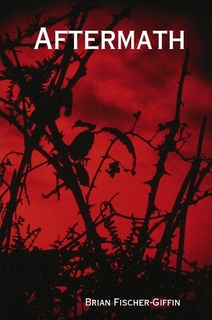
REVIEW: Aftermath by Brian Fischer-Giffin

AftermathCover.jpgPLOT

A plague has descended in the wake of a passing comet. Most people are dead. Biker Talon Willis is one survivor. Teenaged Tahnee Goss is another.

But living through the plague is one thing.

Living through the aftermath is quite another.

MY TAKE

If you're looking for a basic, bread-and-butter post-apocalyptic tale, Aftermath will likely satisfy. Fischer-Giffin's writing (which alternates between Talon and Tahnee's diary entries to tell the story) is straightforward, engaging and, of critical importance, brisk. Fischer-Giffin keeps the action moving forward at all times, which is exactly the right approach. Most readers of Aftermath likely will already be familiar with the conventions of the post-apocalyptic genre, and Fischer-Giffin hews closely to them in his episodic tale, up to and including the expected climactic battle between the forces trying to rebuild civilization and the eeevil marauders out only to rape and pillage. Accordingly, because we readers know what to expect, there is no need for Aftermath to linger; rather, it is a locomotive, allowing us to enjoy the ever-changing scenery, even if we are already familiar with the journey as a whole. (And, to be fair, there are some welcome, if mild, deviations from what I predicted when I started the novel: biker Talon does not turn out to have quite the heart of gold one might expect (tarnished bronze is more like it), and teenaged Tahnee, even making allowances for the fact that her family and friends are dead and she's living in a post-apocalyptic nightmare, is, amusingly, really quite insane.)

AVAILABILITY

Aftermath is available from Lulu as a $3.75 pdf download (or a $19.50 paperback). Fischer-Giffin also maintains a MySpace page.

BONUS RECOMMENDATION

Aftermath may not be particularly innovative, but sometimes telling a simple tale in a straightforward manner can be more fun for the audience than would be a more unconventional narrative. For example, I enjoyed the short film Postapocalyptic Sandpit for most of its increasingly outlandish running time. But as it entered its more surreal final moments, it lost me entirely, both in terms of literal narrative and emotional response. By contrast, I can enjoy the new-wavish song "Among the Ruins", a straightforward soundtrack to the loneliness of life in the post-apocalyptic world by long-dissolved punk 'n' roll band the Vee Gates (which bills its music as "post-apocalyptic rock"), without reservation.

Sunday, May 04, 2008

REVIEW: Vegetation by Mark LaFlamme

VegetationCover.jpgPLOT

Diana Luce loved plants. And they loved her.

Diana's husband, Bertram, didn't particularly love plants. Or her.

So Bertram murdered Diana.

And the plants are not pleased.

Not at all.


MY TAKE

There is not much plot to Vegetation. It is a tale of vengeance for murder, pure and simple. Except that the avenging party is not a bereaved family member, is not even human, but rather happens to be the collective flora of the world. Even so, it is apparent from the start exactly where Vegetation is headed.

So the pleasures of Vegetation do not lie in intricate plotting, although the plants devise many clever means of attack. Rather, the fun -- and there is much fun to be had -- comes from two sources. First, there is author Mark LaFlamme's dry, darkly humorous writing. LaFlamme's omniscient narrator is almost another character in the novel, stepping in to further belittle Bertram and almost giving a voice to the plants who, of course, are unable to actually speak for themselves. For example, when Bertram feels wronged by a bank teller early in the novel, he longs to drive away dramatically after verbally harassing her. But as the narrator makes clear, Bertram is not quite up to the task:


He was so angry, he even considered squealing his tires to add exclamation to his dissatisfaction. Sadly, he did not know how it was done.

And again, the narrator laughs with us (and with the plants) in setting the stage for another floral assault in Bertram's own bathroom:


Two things he learned very quickly: the rigid, pointed leaf of a Mother-in-Law's Tongue was as capable of piercing flesh as a combat knife. And a cactus does not belong in the bathroom.

Vegetation's other amusement, while perhaps more base, is no less genuine. For Vegetation is a novel for those of us who can admit that, on some level, we enjoy seeing evildoers suffer. Sure, some might argue that finding amusement in the torment of another, regardless of whether that person can be said to "deserve" his fate, only deadens the soul and begets more violence. And perhaps those people are right. But regardless of whether it is ennobling, the desire for vengeance is powerfully present in the human psyche. Watching it played out, even (or perhaps especially) in a fictional context (where no one is truly harmed), can be very cathartic. And seeing the pompous, amoral Bertram Luce increasingly harassed by the plants -- the novel makes clear that they are proponents of playing with their victims -- on the road to his ultimate punishment is, to be frank, emotionally satisfying.

But Vegetation actually is not quite so simplistic. LaFlamme goes out of his way to give us the background of Bertram's wretched childhood, so we can better understand the man (and the murderer) he grows up to be. As a result, we are not allowed the unfettered glee of uncomplicated justice. We know how Bertram came to be a monster, and so, even while applauding the plants' revenge, we also sympathize with the boy he used to be.

Yet LaFlamme's sympathy for Bertram, in turn, also is not quite so simplistic. LaFlamme comments on one occasion (after an incident during which Bertram has been brought especially low) that, if Bertram could only maintain the fleeting feelings of empathy and contrition he has been forced to experience, the plants might back off of their retribution. Bertram, however, is incapable of real change. So perhaps we are meant to understand that Bertram is beyond redemption after all, and that his punishment truly is deserved. I don't know if there is a right answer. But I credit Vegetation for being smart enough to raise the question, and nimble enough not to let it detract from the novel's overall fun.


AVAILABILITY

Vegetation is available in paperback for $15.95 from BookLocker, Barnes & Noble, or Amazon. LaFlamme also maintains a website that includes further information about Vegetation and LaFlamme's two other novels, several short stories for free download (and links to a couple more shorts available through Amazon), and lots of other additional content.


BONUS RECOMMENDATION

For more about the nature of vengeance, check out "Vengeance is Ours," a fascinating article recently printed in The New Yorker magazine. Or, for a more musical analysis, check out alternative industrial band Comrade Kommissar (on Four Control Records). For me, the highlight of From out of Nowhere (2004), Comrade Kommisar's only album to date, is "Revenge," on which the Comrade affects a laconic, lounge-esque baritone over a mid-tempo, dark alternative backing to extol the fine art of getting payback:


It has to be dangerous
It has to be refined
It has to be skillful
You need to take your time

Really, what more is there to say?

Tuesday, April 29, 2008

REVIEW: Summerworld by Serdar Yegulalp

SummerworldCover.jpgPLOT

It all starts when psychoanalyst Dr. Hirofumi receives an odd note from Masuda, a former patient, inviting Hirofumi to join Mausuda at a country spa. Odd because Masuda committed suicide three years ago.

And that is just the beginning. Hirofumi soon discovers that the veil of perceived reality has been ripped away altogether, and the rules of the old world no longer apply. What is left behind is called Summerworld. It is a realm where people can be who they want to be. Or at least who they view themselves as being. And Summerworld is changing to meet the expectations of those who inhabit it.

But Hirofumi also learns that straddling the line between your past and your hopes and dreams for the future can be tricky. Not everyone can walk that tightrope and make the transition. Especially when forces are gathering to push Summerworld entirely off balance.

MY TAKE

It is really quite impressive how Summerworld pulls together its seemingly divergent stylistic threads into such a satisfying tapestry.

Summerworld is deeply philosophical. Author Serdar Yegulalp presents a thoughtful meditation on the fine balancing act between clinging to the past and losing oneself in dreams of change. Yet, philosophy aside, Summerworld also contains several wonderfully involving action scenes. And happily, Yegulalp knows that a battle is all the more exciting when the sides are evenly matched. It never feels like the villains are too strong, and thus that the heroes can only prevail through luck or authorial caprice. Rather, even at the final, spectacular confrontation, there is a pronounced sense of balance, and that only heightens the tension.

Summerworld is in many ways a fantasy novel. It takes place in the world of magic, warriors and dreams that emerges after our modern society has been pushed aside. But the novel also is grounded in reality. On a literal level, remnants of our present world linger even after Summerworld rises. More importantly, many of the characters carry the baggage of their prior lives. As a result, Summerworld's characters feel completely genuine and of this world, notwithstanding their larger-than-life fantasy trappings. On the outside they may be heroes, but on the inside they're people.

Summerworld has a powerfully epic quality. Hirofumi's journey to understand the nature of the threat that surrounds him is fully developed and feels complete. Yet Summerworld also tells smaller, intimate stories about the relationships, both old and new, that are forged in this new world. And these small, understated character moments are just as compelling as the overall saga.

Summerworld's final apparent contradiction is that, despite the scope of Yegulalp's achievement, the novel is in fact only 284 pages long. So even if you're pressed for time, there is absolutely no reason not to go and pick up this fine novel.

AVAILABILITY

Summerworld is available from Lulu (as are Yegulalp's other novels) as a $14.99 paperback. Yegulalp also maintains a personal website that includes, among other information, news about various past and upcoming projects.

BONUS RECOMMENDATION

The members of Mystechs recently announced that they are putting the band on hiatus while they head to Hollywood to pursue their moviemaking dreams. It is hard to argue with their logic: after ten albums in as many years with limited commercial success, they feel it is time, at least for a while, to focus on other creative endeavors.

Happily, while moving forward, the band members appear also to value their years in the music trenches. As one member comments in a recent blog entry, "I don’t think I’m being full of shit when I say I wouldn’t trade the Mystechs experience to play in 98% of the bands that get lots of hype or sell lots of records." Nor have they foreclosed the possibility of returning to music some day, even as they focus for the moment on their filmmaking.

In the meantime, the band leaves behind a substantial musical legacy recorded in several different pop and rock styles. The earlier albums tend to be a bit hit or miss, although they include some songs I truly love, like the bouncy, clever political dance pop of "Shouldn't Be Dancing" from Showtime at the Apocalypse (2002). But the more recent albums, each of which is a witty pastiche of a particular genre, are much more consistent: Dixie Inferno (2008) is a riotous take on southern rock, Hot Tub O' Blood (2007) is an equally warped take on heavy metal, and Escape from Planet Love (2006), my personal favorite, takes on '70s disco and funk.

Straddling the early- and late-period albums is 2005's Warriors and Warlocks, a (very) loose concept album about using fantasy to escape the drudgeries of the workaday world. Any horror movie aficionado will appreciate "Zombie Mountain," an exhilarating three-and-a-half minute zombie flick with a hillbilly twang. But the highlight is title track "Warriors and Warlocks," about a suburbanite's dream to leave behind her "white-bread paradise" for a more exciting world where her inner elven princess can fight dragons, devils and demons. Not a novel theme, certainly, but one that the Mystechs handle with charm, sympathy, and a nicely propulsive chorus.

More information about purchasing all of the Mystechs' albums (including iTunes links for the more recent releases) can be found at their website.

Tuesday, April 22, 2008

REVIEW: Imaginary Friends by Darren Pillsbury

ImaginaryFriends.jpgPLOT

Jeff Tanner is trying his best to be a good father to his two young sons after the death of his wife. But it's not easy. His youngest son, Davey, is a mischievous smart-aleck. Older son Brian has withdrawn altogether, focusing only on his drawing. And Jeff himself is both lonely and uncertain how to move on.

But now things have gotten even worse. Jeff has started seeing strange, freaky creatures wherever he goes. Strange, freaky creatures that are becoming increasingly upset. And Jeff had better figure out why, because that agitation is turning into outright hostility. Towards Jeff. And they may be little, but they're everywhere.

MY TAKE

There are no big surprises in Imaginary Friends. From the moment young Davey makes a Christmas wish that his father could see all of Davey's imaginary friends, we know that wish is going to come true. We know that the imaginary friends will cause chaos, but that, ultimately, they will help Jeff recognize what's important in life. We know that, as part of this process, Jeff will learn how to honor his wife's memory while also moving on, and that this lesson will revitalize both his relationship with his children and his career. Imaginary Friends is a story of holiday redemption; as such, there's only one place for the story to go.

But that's OK, because even if we know the eventual destination, the journey is a lot of fun. Pillsbury displays a flair for both big, comic set-pieces and quieter moments of loss and melancholy, and Jeff and his family and friends are charming, likable protagonists. Some characters, like precociously cute youngest son Davey and Jeff's spunky live-in mother-in-law, feel a bit too much like standard television sitcom archetypes. But others, like Jeff himself and introverted son Brian, keep the novel grounded; they're real people, with real flaws and problems that resist instantaneous resolution. Even the "imaginary friends" themselves, rather than being strictly cute 'n' cuddly, are appropriately menacing when riled.

As a result, although Imaginary Friends as a whole displays an appealing tenderness, it never descends into treacly holiday pap. Rather, there is enough bitterness mixed with the sweet to keep the reader involved, and this vitality easily compensates for the lack of narrative surprises. After all, we may know already know that the Grinch is going to learn to love Christmas; but that doesn't mean we can't still appreciate the real emotion underlying the tale.

AVAILABILITY

Imaginary Friends is available for $12.95 from Amazon. You can read the first 80 pages of the novel for free at the book's website; further material, including the beginning pages of a webcomic adaptation of the novel (as drawn by Pillsbury himself), is also available here.

Incidentally, and unfortunately, the latest blog entry on the webcomic site illustrates how difficult it is for even a well-reviewed POD book to achieve much success. If you look at the nine (to date) customer reviews on Amazon, you'll see that Imaginary Friends has been widely praised, not just by the usual friends and family, but also by an Amazon top-100 reviewer, two top-50 reviewers and a top-10 reviewer. I'm aware of the debate about the worth of some of Amazon's top reviewers; nonetheless, one might think that having so many positive reviews would count for something.

But Pillsbury's blog reveals that "sales of the book have stunk," well below the (fairly minimal) 200-300 books he hoped to sell. The problem, of course, is that favorable reviews on Amazon can only sway readers who have already found the book. As always, the problem is getting the potential customer's attention in the first place. And as always, even for the worthy titles, there is, unfortunately, no easy solution.

BONUS RECOMMENDATION

Glen and the Sunshine Gang are a fun, quirky power-pop band that sing about fun, quirky topics like Jackie Chan ("Jackie Chan"), Jason Voorhees ("Friday the 13th"), and Billy Blanks ("Winners Anthem," which also has a nifty video).

Oh, and unicorns. Following their adventures in Imaginary Friends, I can perfectly imagine Jeff and his family singing along to the rousing chorus of "I Believe in Unicorns." I have a bit more difficulty picturing the family singing along with the ugly, death-metalesque bridge two-thirds of the way through, but even that aspect of the song is thematically consistent with the novel: just as Jeff's preliminary mistakes and failures make his ultimate growth all the more compelling, so too does the ugliness of the song's bridge make the final chorus that much sweeter.

All of Glen and the Sunshine Gang's songs are available DRM free for $0.89 each through Snocap on the band's MySpace page (where the band's two videos can be seen as well).

Sunday, April 13, 2008

REVIEW: Timely Persuasion by Jacob LaCivita

TimelyPersuasion.jpgPLOT

I don't usually do this, but today I am simply going to quote Timely Persuasion's official blurb (see here or here) as my plot description (trust me, I have my reasons):

What did Kurt Cobain, Jimi Hendrix, and my sister have in common? They were all my friends, and they died. Timely Persuasion follows an anonymous music critic on a quest to save his sister from the relationship that ended her life. After a chance encounter at a bowling alley leaves him with the ability to travel in time, our hero uses his musical knowledge to “blink” through the years attempting to keep the couple apart by any means necessary. But is her husband Nelson really to blame? Along the way he launches a new folk rock star, accidentally restructures his family tree, and crosses paths with the likes of Huey Lewis, Bob Dylan, Paul McCartney, and Billy Joel. Reliving past events through the eyes of his younger selves, he soon finds that correlation and causation are not always what they seem. This story of death, life, love, and rock 'n’ roll defies genre conventions while paying tribute to the classic time travel tales that came before it.


MY TAKE

Timely Persuasion reflects a peculiar phenomenon that is common in mass-market releases, where hired gun publicists write the back-cover copy, but is less usual in the do-it-yourself POD world. To be blunt, Timely Persuasion's misleading plot blurb makes a fun novel sound absolutely cheesy. Based on the official description (with its promise that the hero is "friends" with Cobain and Hendrix and also "crosses paths" with assorted other rock luminaries), I suspected that Timely Persuasion would be a series of trite wish-fulfillment trysts between a thinly-veiled author-stand-in protagonist and his musical idols, which in the end would add up to little more than a collection of fanboy fantasies.

Happily, Timely Persuasion absolutely does not go down this road. The conceit of the novel is that time travel is possible to any date that resonates strongly in the traveler's memory. For our time-traveling protagonist, those days often have rock music significance. However, our hero does not actually interact with his music idols. Rather, although his remembrances of important music dates are the springboard from which he launches his travels through time, they really are just the backdrop to his real mission: to prevent his sister's suicide.

And so Timely Persuasion ends up being much more enjoyable than the the above description had led me to expect. The writing is professional and polished, and author Jacob LaCivita does an admirable job keeping the complex mechanics of his recursive plot clear for the reader. At times his exposition is a bit too blunt, as one character will spell-out for another exactly what is going on. But that's really no different than Doc Brown drawing on the blackboard to explain the intricacies of time travel for Marty in Back to the Future Part II. And Timely Persuasion is clearly a movie at heart. Indeed, on April 1, LaCivita joked on his blog that Timely Persuasion had already been snatched up as a movie with an all-star cast. Although LaCivita was kidding, Timely Persuasion absolutely has "summer blockbuster" written all over it.

Of course, as I've mentioned before, big-studio summer films are known for being fun and clever, but also for ultimately being disposable. Indeed, Timely Persuasion raises a number of intriguing issues that it never fully explores. For example, the narrator at one point funnels hit songs from the future to a singer from the past, in order to advance the past performer's career. He expressly recognizes that in doing so, he is effectively depriving the future (original) artists of writing (or profiting from) their own songs. Maybe it's just me, but I find the implications of that fascinating (not just in the chicken-and-the-egg paradox sense; what I really find interesting is the ethical and artistic issues). And so perhaps it is unfair of me to criticize LaCivita for staying focused on the tale he wanted to tell, rather than going off on a tangent that I was interested in. But it is very frustrating to have interesting themes explicitly raised, only to be quickly brushed off to the side.

Nonetheless, high-concept films and novels definitely have their place, and Timely Persuasion fits solidly in that category. I enjoyed it for its substantial cleverness, breezy style, and pleasingly convoluted plot, which had just enough pathos at the end to give the journey some substance. If I'm a bit dissatisfied with Timely Persuasion, it is only because I would have liked more focus on some of the side-issues. But even as the novel stands, it is great for beach reading, and there's absolutely nothing wrong with that.

However, I would still change that back jacket copy.


AVAILABILITY

Timely Persuasion is available as a $16.00 paperback or a $5.00 pdf download through Lulu. Alternately, you can read the novel for free through an online reader at the Timely Persuasion website, where further background information is also available. Even more information is available at the novel's blog, including an ongoing series of chapter-by-chapter author's notes and comments. Finally, random bits and pieces thematically linked to the book are available at Local Blog Done Good (the name has significance once you've read the book). LaCivita clearly takes marketing his book seriously (for which he should equally seriously be commended).


BONUS RECOMMENDATION

In the spirit of Timely Persuasion, I offer up a music track that always pulls me back in time (not from an independent artist, alas -- this dates back to a time before I discovered that wonderful world): Ratt's "Round and Round" (the link is to the DRM-free Amazon music store). Back in 1983, I thought this was a great song; to be honest, I still do. And, should a movie adaptation ever be made, I think "Round and Round" would be the perfect choice to play over the credits. Anyone, or at least anyone from my generation, would instantly understand the concept that pop music can transcend time and create a tunnel straight back through the decades (has it really been 25 years?). And while I know that the song isn't actually about time travel, I don't think anyone really knows the lyrics beyond the perfectly apropos "Round and round/what goes around comes around/I'll tell you why" anyhow. So cum on feel the noize! (oh wait, that was someone else.)


Sunday, March 16, 2008

REVIEW: Voltage by Justin Conwell

Voltage.jpgPLOT

After attempting suicide, Eric had his self-destructive thoughts blasted out of his head through Electro-Convulsive Therapy. Unfortunately, the therapy also stole his memory of what drove him to suicide in the first place. Even worse, it tore away the creative part of Eric's brain, leaving the former painter without the inspiration to do much more than work as a clerk at the local discount store.

Now a year has passed, and Eric's daily routine is upended when the latest load of donations includes a box filled with ashes and labeled "Harold." Pressed into a road trip to bring Harold's remains back home, Eric finds himself forced to confront both his current life and the past that got him there.

MY TAKE

Over a year ago, I wrote a brief review of Saints Visible by "Justin Gil." I described the novel as a "charming, folksy tale" with considerable "laid back charms," although I found the resolution to be "rather abrupt" and "too easy."

I have been told that Voltage, attributed to a "Justin Conwell," is in fact the same author's second novel. Based on the evidence of the two books, I certainly believe it. Voltage demonstrates the same strengths as Saints Visible: a clear, inviting writing style that immediately draws the reader in. Voltage, however, is a considerably greater triumph, as it marries those strengths to a much more mature and involving story.

With its themes of suicide and long-buried memories, the novel may sound exceedingly glum or melodramatic. And indeed, as one might expect, Eric's buried memories do conceal a tragic story that ultimately impact his present as much as his past. However, Voltage is not a melodrama. Rather, Voltage is a tragedy, in the most positive (if not quite Grecian) sense of that word.

Like any good tragic hero, Eric is both deeply flawed -- indeed, infuriating at times -- but also deeply, recognizably human. Conwell draws us into Eric's tale slowly; although dark rumblings can be heard from the start, the early part of the book is fairly relaxed, and even whimsical. But as the story progresses, we grow to care about Eric and his traveling companions (including romantic interests both actual and potential). When Eric's failings and history inexorably surface, there is nothing flashy or over-the-top about the results; everything in Voltage feels real, and plausible. And this quiet power makes Eric's journey all the more affecting.

Indeed, by the end of the novel Eric and his friends have all learned, in one way or another, that you cannot run away from your past. This is, of course, an ancient literary theme, dating back (at least) to the aforementioned classical Greek tragedies. Yet Voltage distinguishes itself through compelling characters that make its exploration of this well-worn trope feel fresh, powerful, and, ultimately, heartrending. Saints Visible was worthwhile as a cute "feel good" book; Voltage, by contrast, is a genuine work of art.

AVAILABILITY

Voltage is available from Lulu here as either a $0.50 download or an $11.99 paperback. Saints Visible is also still available from Lulu, either as a free download or an $8.56 paperback. The author does not appear to have a website; nor am I aware of any other books he may have written, whether as Justin Gil, Justin Conwell, or some other pen-name.

BONUS RECOMMENDATION

The Sheds have made all four of their folksy rural rock albums available for free download, and I strongly recommend that you take them up on their generosity. Each is strong, but the most recent two -- The Sheds Quit Smoking and You've Got A Light -- are especially stunning. The Sheds sing about the small issues of day-to-day living, and, appropriately enough, their songs encompass the gentle humor, quiet yearning, and upbeat joys of everyday life, while also maintaining a consistent and intense melodiousness. These guys should not be missed.

Monday, February 05, 2007

REVIEW: Fake Girls by Matthew Sloan

PLOT

Molloy might pass as a real private investigator if he had a bit more class. But as things stand he's a scavenger. People who are desperate somehow find him. For a fee, he helps.

Nada Klone is the internet's hottest adult personality. And she's missing. Two powerful opposing factions have each commanded Molloy to find her, or else. Now Molloy is trapped in a nightmare, caught between these mysterious forces and his own equally murky passions in his quest for a woman who is as elusive as the internet itself.

MY TAKE

Fake Girls does many things well. It is wonderfully written: the sleaze that permeates Molloy's life oozes off the page, and Molloy is a likable narrator whose sardonic sense of humor enlivens the story without undercutting the situation's menace. The mystery, although more philosophic than literal, is compelling. And, unusually for so metaphysical a story, the ending is terrific, with a satisfying conclusion that neatly both encompasses and builds upon all that has gone before.

Fake Girls has many interesting points to make about the nature of reality and personality in the digital age. However, the most intriguing -- and touching -- part of the novel is its exploration of who and why we love (kind of like a grindhouse version of Enola's Wedding). Molloy has a genuinely tender relationship with a transsexual prostitute, and then a more lustful affair with a woman he meets during his investigation. A husband loves the wife who cheats on him constantly. A man searches for his online lover, with no prejudice about who that may turn out to be. In all of these instances, Fake Girls quietly but firmly imparts its message: love is where we find it, and we simply have to adapt.

AVAILABILITY

Fake Girls is presented by the Afterhuman Press and published through Lulu. Until recently, it was available for purchase as a paperback or a pdf ebook directly from Lulu; however, the Lulu link appears not to be working at the moment. Hopefully it will revive shortly; until then, the novel is available as a Lulu-printed paperback on Amazon ($15.96). Matthew Sloan appears not to have his own website.

BONUS RECOMMENDATION

Spray is a great synth duo who produce outrageously fun pop music. Not only do their songs consistently impel me to dance (and I am rather hard to get in motion), but, surprisingly for the genre, the lyrics are witty and just as worthwhile as the music. Spray has just released a splendid new album, Children of a Laser God. Among the highlights are several songs about the illusory and mysterious nature of relationships, including "He Came With The Frame," about the merits of treating the guy pictured in a new photo frame's marketing insert as your significant other; and "Pretend Girlfriend," about the advantages of paying someone to pretend to be your partner in front of your friends.

Children of a Laser God is available for download on eMusic, as is Spray's equally outstanding first album, Living in Neon. (If you can tolerate buying music encumbered with DRM, both albums are also available on iTunes). Living in Neon is also presently available as a physical CD from CDBaby; hopefully Children of a Laser God will soon be as well.

Friday, January 19, 2007

REVIEW: Bass Desires by DJ Lufkin

PLOT

Jude Barnes is nearing forty. His music career has gone nowhere, his trust fund is almost depleted, and Rachel, his wife, thinks that it's time for him to get a "real" job.

But Jude has just met Nerfertiti. Nefertiti can sing. Her talent could even push Jude's little bar band into the big leagues. If Jude can convince her to stay with the band. And if Jude wants to stay himself.

MY TAKE

Jude Barnes is kind of a jerk. And that's what makes Bass Desires interesting.

DJ Lufkin is a proficient writer, and Bass Desires is an enjoyable read with a brisk narrative flow. The problem is that the reader can predict the entire plot from the back cover blurb. A beleaguered hero, searching for that one last chance to fulfill his dreams, will overcome both his materialistic wife and a soul-numbing white-collar career opportunity to find musical, spiritual and maybe even romantic fulfillment with a new muse. And so the novel goes. Indeed, Jude and Nefertiti's relationship, while well written, is the least involving part of the tale.

However, Lufkin has an uncommon and welcome perspective on Jude's relationship with Rachel. Jude is not a wholly sympathetic hero: he has cheated on his wife in the past, and seems a bit too willing to do it again. Nor is Rachel wholly unsympathetic: Lufkin displays some empathy, or at least understanding, for her desire to live a more comfortable life after struggling through years of Jude's pursuit of a music career (and other women).

Perhaps most interesting is Jude's response when Rachel forces him to attend a motivational seminar. The speaker advises that sometimes one has to place one's own dreams above all else, even if it means leaving other people behind. Jude is disdainful of this trite aphorism, recognizing that it justifies both Rachel's desire to move into middle-class respectability and his own desire to continue to pursue his musical goals. In other words, it solves absolutely nothing. But at the same time, Jude seems to understand that his desires are not better than Rachel's, just different. He has sympathy for Rachel even as he chooses to pursue his own wants and objectives and their relationship teeters on collapse, a tension that persists to the end of the novel.

Or rather, I think that tension exists. To be honest, the shadings are subtle. I wonder if I'm seeing things that aren't there. Despite what I've said, Lufkin still portrays Rachel as a bit too shrewish. And he stacks the deck against Jude's potential new career as an investment advisor by not only making his workplace stressful and boring but also outright corrupt, which makes Jude's choice to reject that lifestyle much less interesting. Moreover, Lufkin doesn't really explore the difficult question of whether, at some point as the years fly past, it becomes unreasonable to continue to devote all of one's time to pursuing an artistic dream.

To the extent I'm correct about Lufkin's intent, I appreciate his efforts at giving his characters depth and balance. But I wish he had gone a little bit further in that direction.

AVAILABILITY

Bass Desires is available in paperback for $14.95 from iUniverse or Amazon, or as an Adobe eBook (a restricted-use format that I adamantly oppose) for $6.00. DJ Lufkin has both a dedicated website and a MySpace page for the novel; however, neither provides any substantive content beyond advertising the book's existence.

BONUS RECOMMENDATION

Dreams don't always come true. Genuinely talented artists give up every day without achieving any recognition or success in their chosen field. I mourn the passing of Cubic Feet, a splendid powerpop band that never garnered much attention and, as far as I can tell, called it quits by 2002. Although the band is no more, all four of their albums remain available on CDBaby, including the exemplary Passenger in Time. Should CDBaby ever sell out its stock, three of the four albums (including Passenger in Time) are also available at iTunes, albeit encrusted with iTunes DRM (which, as I've mentioned before, drives me crazy). Unfortunately, Cubic Feet's albums are not available for download at either of the non-DRM legal download sites I frequent (eMusic and MP3tunes).

Monday, January 08, 2007

REVIEW: Continuity Slip by Till Noever

PLOT

Ray Shannon is an ordinary guy, driving home on an ordinary day.

But then Ray saves a stranger named Alyssa Weaver from certain death, pulling her from her burning car in the midst of a massive freeway pile-up.

Now Ray's entire world has changed. Literally.

The highway on-ramp that used to have one lane now has two. Ray's colleagues at work have been replaced by new faces. Ray's wife suddenly hates him.

Even worse, the cops suspect Ray of murder.

And worst of all, the evidence points to one conclusion: they're right.

Now Ray and Alyssa need to work together to figure out what's going on, before everything they know slips away forever.

MY TAKE

Continuity Slip reads like an archetypal summer Hollywood movie. The writing is clean and polished. The narrative pushes forward relentlessly. Parallel universes are always fun, and the philosophical conceit at the heart of the novel -- the way little changes in experience might cumulatively impact a person's entire nature -- is intriguing. Ray and Alyssa are a likable couple, and their romance is not only part of the plot, but cleverly explains the plot (and yes, I know that sounds rather cryptic).

However, also like many big-studio films, Continuity Slip feels a little shallow. Although the novel raises interesting concepts, it never explores them. All of the recondite discussion about alternate realities ends up serving only as background color for a standard murder mystery that could just as well have happened in this reality. The two plot threads never significantly mesh. Indeed, once the mystery is resolved, the shifting realities thread is wrapped-up very quickly, almost as an afterthought.

I look forward to reading more works by Till Noever. He plainly is very talented, and Continuity Slip is nothing if not professionally written. The strength of Noever's style and the affability of his characters easily carried me through the novel. I only wish that the journey had lived up to its full potential.

AVAILABILITY

Continuity Slip is available as a pdf download from Lulu ($1.45) or in paperback from either Lulu ($9.99) or Amazon ($13.00). Till Noever also has a website which provides details on his other novels (and which, annoyingly, auto-shrinks my browser window).

BONUS RECOMMENDATION

Clubbo Records' website claims that "[f]or more than 40 years Clubbo Records has epitomized the maverick spirit of the old-school independent record labels." It speaks proudly of the label's history of issuing "bold, if sometimes ill-advised music," and includes detailed biographies of some of Clubbo's biggest hitmakers over the years.

However, Clubbo Records does not really exist. The website is a big, elaborate joke. So elaborate that the site includes dozens of song pastiches representing Clubbo's hits over the decades. These songs perfectly capture the sound and feel of their (supposed) eras. More than that, they're really good pop songs as well. There are many highlights, including the brilliant progression of one song ("Yeah Yeah No No No") from mournful 60s ballad through 70s folk-rock remake and 80s dance hit to cat food jingle. (Indeed, Clubbo's songs are not only available for streaming on the website, but are deservedly available for purchase in two compilation volumes available on iTunes, CDBaby, and eMusic).

Personally, I get nostalgic over Clubbo's early 80s band Bleep. Bleep may be best known for "Rubber Lover" (their paean to inflatable sex toys). But who could forget (if it had ever existed) Bleep's thought-provoking masterpiece "Space Doors," with its profound ruminations upon the manifold nature of reality ("There are doors in space / leading somewhere else / where you're face to face / with your other self")?

Saturday, December 23, 2006

REVIEW: Enola's Wedding by Jack Mauro

PLOT

An unprovoked bee sting hobbles Enola Tyrwhitt. Drew Morrigan, ever the gallant knight (and, in this instance, the noble steed as well) comes to her rescue, sweeping Enola off her feet and carrying her to safety.

After so romantic a first encounter, what choice do Enola and Drew have but to wed?

In ways both profound and minute, Enola and Drew's engagement reverberates far beyond the happy couple. As does Enola's slow realization that, just maybe, she and Drew are not quite soul-mates after all.

MY TAKE

Enola’s Wedding tells several love stories. It tells of love amongst friends, family, and lovers; of love that is returned and that is unrequited; that redeems and that demeans; that persists and that withers.

Contrary to the common edict, Mauro often tells rather than shows. He does simply recount his characters' actions and thoughts. Rather, he comments and philosophizes, observes and contradicts, editorializes and explores. Mauro’s narration dominates the tale.

This approach has its risks. Such an idiosyncratic style can easily descend into irritating self-parody if not handled with consummate skill. Indeed, Mauro’s characters initially wilt into an undifferentiated mass in the shadow of his overwhelming personality.

However, Mauro proves more than equal to the challenge. His writing is, quite simply, glorious. His voice is insightful, funny, and captivating. He swoops in and out of characters’ thoughts, histories and feelings, and then darts into illuminating analogies, reflections and homilies. The reader may constantly be aware of Mauro as narrator. But Mauro understands his characters too well, and talks about them too vividly, for them not to develop as full and sympathetic individuals.

Nor does Mauro's inventiveness hide his fundamental compassion for his characters. This empathy does more than soften Mauro’s often arch tone. It elevates Enola’s Wedding from being a mere stylistic showpiece into being a truly moving, wonderful meditation on the manifold nature of love.

AVAILABILITY

Enola's Wedding is available through iUniverse and Amazon, as is Jack Mauro's stylistically similar, and equally wonderful, Spite Hall. Mauro’s decision to publish through iUniverse is fortuitous; as I discussed here, iUniverse allows customers to preview the books it publishes, so you can check out Mauro’s writing before laying down your money to confirm whether you find it as enthralling as I do.

Additional information about Mauro is available on his homepage, although as of this writing its current focus is Mauro's upcoming guide to online dating (due to be published by Simon & Schuster in 2007). I wish Mauro the best of luck with this book, but must admit I hope he returns to fiction one day.

BONUS RECOMMENDATION

David W. Jacobsen is a singer-songwriter with a distinctive voice, both in terms of his vocals and his compositions. Jacobsen’s quirky edge sets him apart even when addressing well-worn matters of romance and loss. His virtues come to the fore on The Chasm.

As Jacobsen notes on his website, The Chasm is “about the gap between people who are trying to connect.” While a bit overlong, the album is a fine tribute to the humor and pain of love. Among several highlights, “Jacqueline” beautifully elegizes a relationship that cowardice killed before it could even begin; “Dry Spell” is a humorous folk mock-anthem about Jacobsen's solidarity as “one of many not getting any” (sex, that is); and album-opener “10,000 feet” rages, in a polite folk-rock way, about a woman trying so hard to be special that she isolates herself from the man who is trying to treasure her.

The Chasm, as well as other Jacobsen albums, is available for purchase on CD from CDBaby, or as MP3 downloads from eMusic, or, if you don't mind being subject to Apple's DRM restrictions (which I personally find abhorrent), from iTunes. Just like iUniverse, all of these sites offer previews, so you can sample Jacobsen's voice before you buy.