Showing posts with label iUniverse. Show all posts

Tuesday, May 27, 2008

REVIEW: Do the Math by Philip B. Persinger

DoTheMathCover.jpgPLOT

William Teale, long ago a math prodigy, now spends his time teaching at a small university in the Hudson River valley. He is deeply in love. But not with his wife.

Virginia "Faye" Warner, William's wife, is a romance novelist. Her books all follow a rigid -- and successful -- formula. But her reality falls fall short of her fairy tale public façade.

Claire is the woman William lost twenty-five years ago -- and never forgot. And now, by chance, she has shown up again.

Roger, William's graduate intern, finds himself bearing witness as the destinies of William, Virginia and Claire intersect during the course one fateful school year. But in Virginia's romance novels, the rules of love are clear. In the real world, affairs of the heart are rarely so precise -- or straightforward.

MY TAKE

To its credit, Do the Math is not a novel of overblown passions. To be sure, there are momentary explosions, both of fire and of humor. But the strength of the novel lies in its tender, sympathetic portraits of the lonely and middle-aged trio at its core: William, a man trying to do right by his wife, even if that means stifling his own happiness; Virginia, a woman who, in her own fashion, is just as trapped as William; and Claire, the "other woman" who is flung by fate into the middle and who, perhaps not entirely unwillingly, is unable to extricate herself. Because these characters feel genuine, we care about their story, even if it does not involve the standard young hunks or ladies with heaving bosoms that lie at the heart of most romance tales.

So the fact that Do the Math does not rise to the extravagance of a typical romance novel (no pirates, for example, and the coma and hospital romance aren't what one might expect) does not detract from the novel at all. Rather, the book's unaffected elegance and overall good humor (combined with Roger's charming narration) more than carries the reader through. And given that the novel's primary conceit is to explore an ultimately unanswerable question -- whether true romance can be boiled down to a logical equation -- the fact that Do the Math nonetheless both satisfies and is satisfyingly unpredictable right through to the end is a testament to author Philip B. Persinger's achievement (and, perhaps, to how unimportant the question really is).

AVAILABILITY

Do the Math is available as a $17.95 paperback (or a $27.95 hardcover) from iUniverse, Barnes & Noble, or Amazon. Author Philip B. Persinger also maintains a very bare-bones website for his novel here.

BONUS RECOMMENDATION

Love is, of course, a fundamental, ancient and ever-fertile subject for all manner of art and expression. On the lighter side of the spectrum, check out Erin Cosgrove's hilarious, smart romance novel parody The Baader-Meinhof Affair ($14.95 from Amazon; out of stock at Barnes and Noble). Some bonus material is also available at her website here.

On the far opposite end of the range, Daniel Johnston's majestic, tragic, beautiful, utterly heart-rending "Some Things Last A Long Time" (originally from his album 1990) is absolutely not to be missed. Johnston is definitely an acquired taste (see a detailed discussion of his life and music here), but the raw emotion of this song blasts through the substantial technical limitations of the recording. "Some Things Last A Long Time" can be purchased as an individual track, as part of the 1990 album, or as part of the wonderful introductory compilation Welcome to My World, which is available from, among other locations, either eMusic or directly from Johnston's webstore.

Tuesday, May 20, 2008

REVIEW: Stray Not Beyond by Michael B. Pinkey

StrayNotBeyondCover.jpgWARNING: mild spoiler ahead, for those who like to know no more about a novel's plot than what the back cover reveals.

PLOT

All Irving Carlisle wanted was to find some more Suttlespyce (Number 17), the finest pipe tobacco he had ever smoked.

All Irving found in Otterwood, North Carolina -- home of his beloved Suttlespyce (Number 17) -- was some decidedly unfriendly locals.

Then he got lost, and found something else, too. The entryway to a different world. A very unpleasant different world.

MY TAKE

Is it fair to criticize Stray Not Beyond for not telling the story I wanted it to tell? I've previously discussed the frustrations of having a novel side-step a specific plot point I found particularly intriguing in favor of pursuing a different agenda. But Stray Not Beyond takes the problem -- and thus my dilemma -- to an extreme.

The novel starts on a folksy, low-key note, as Irving recounts how a sample of the preternaturally sumptuous Suttlespyce (Number 17) pipe tobacco arrived, unsolicited, in his mail one day from a Theodamus Rroyhall in Otterwood, North Carolina, and how Rroyhall equally suddenly stopped responding to Irving's orders two years later. So Irving sets off for Otterwood to investigate.

In Otterwood, the locals start by giving Irving the run-around, and then become even more hostile when Irving persists. And although the novel's tone becomes increasingly dark, I thought I knew, at least generally, what I was in for: the story of Irving's investigation into the mysterious Rroyhall and his Suttlespyce (Number 17). I wasn't sure how dark the story would get, or exactly where the plot was headed. But the laid-back, appealing narrative style and intriguing plot had me primed and eager to see how the mystery would play out.

But then, on page 56, everything changes. Irving finds himself no longer in Otterwood, but in a quite literally different world altogether. From that point, the novel proceeds through an episodic series of surreal, hellish encounters as Irving struggles to find a way home. Although author Michael Pinkey ultimately does tie everything together in a fairly satisfactory manner, the story of Rroyhall and Suttlespice (Number 17) -- and, indeed, any story beyond Irving's bare struggle for survival -- takes a distinct back seat for the remainder of the story, as Stray Not Beyond essentially becomes a travelogue through a nightmare.

To be fair, Stray Not Beyond is a very well-written travelogue. Pinkey recounts the individual elements of Irving's nightmare journey with consummate skill, and individual scenes are genuinely creepy and effectively convey Irving's desperation and hopelessness. Unfortunately, these scenes never come together into a compelling overarching narrative: they remain a serial assortment of disparate events.

And so Stray Not Beyond is, above all, frustrating. Through page 55, I did not know exactly where the story was going, or even what genre the novel was going to end up being (it seemed capable of going anywhere from whimsical rusticity to black comedy or even violent thriller), but I did expect that the story as already started was going to continue. Unfortunately, when Irving loses his way, so too does Stray Not Beyond.

AVAILABILITY

Stray Not Beyond is available as a $14.95 paperback (or $24.95 hardcover) from Barnes and Noble or Amazon or direct from iUniverse. Pinkey -- who appears to date not to have published anything else -- also maintains a bare-bones website for the novel.

BONUS RECOMMENDATION

David Zimmerman's Socket (available from Barnes and Noble or Amazon) also goes in a different narrative direction than I had initially expected. However, I have to admit that Zimmerman's direction works beautifully; indeed, Socket has quite simply become one of my favorite novels, period. I have more to say about Socket, but consider this a cliffhanger: check back next week for my review roundup of the last decade of winners (including Socket) of that thirty-year Labor Day weekend tradition, the 3-Day Novel Contest.

Wednesday, April 02, 2008

REVIEWS: Strange Sleuths: Three Novels about Peculiar P.I.s

Mickey Spillane's Mike Hammer. Raymond Chandler's Philip Marlowe. Robert Parker's Spenser. Hard-boiled detective thrillers are a venerable and beloved staple of American literature. To be honest, I have never been a tremendous fan of the traditional crime novel. But that is not an issue with any of the three novels below, each of which takes the detective novel is a wholly unconventional direction.

WildClownHijacked.jpgWildclown Hijacked by G. Wells Taylor is the most straightforward of the bunch, which is really saying something given that the novel chronicles the adventures of a spirit, in the quasi-post-apocalyptic world of the Change (in which the dead have arisen to resume their old lives), who possesses the body of an alcoholic private investigator who, in turn, wears clownface greasepaint in order to hide his face -- and thus his past -- from his own gaze.

Wildclown Hijacked is the sequel to When Graveyards Yawn, a novel I absolutely adore, and, perhaps unfairly, the new installment suffers a little bit in comparison. The problem is not with the writing; Taylor's prose continues to be absolutely top-notch. Wildclown's gritty, down-to-earth narration perfectly counterpoints the nightmarish phantasmagoria of life after the Change, and Taylor captures the mystery, violence and horror of this new world beautifully.

Rather, it is the plot that falters. To anyone already familiar with Wildclown's world (or even who has just read the above paragraphs), the title of this novel explicitly gives away exactly what is going to happen. Moreover, beyond the titular event, not much else occurs. As a result, there is very little surprise as events unfold. The details of the journey are everything. The strength of Taylor's writing is such that it is nearly enough. But in the end, Wildclown Hijacked was a little bit too predictable, even with its completely over-the-top finale.

(Wildclown Hijacked is available as a $9.94 paperback when ordered from Lulu through a special link at the book's web page -- go to wildclown.com and click on the Wildclown Hijacked cover there.)

UselessDetectiveCover.jpgOn the surface, Robert Barry Kaplan's The Useless Detective appears much more conventional. Our narrator, a small time P.I. so lackadaisical that he doesn't even get a name, has managed to rouse himself to attend a twenty-year college reunion party at an isolated country estate. Before the night is over, one party goer has been murdered and a sudden storm has cut off all contact with the outside world. No one has any faith that our narrator can solve the crime before the killer strikes again. This, it would seem, would be the perfect opportunity for our hapless "hero" to prove his worth.

But we humans don't always rise to meet the opportunities presented to us. Sometimes, when given the chance to shine, we just stay in our ruts. And so it is with our useless detective, who, in fulfillment of his classmates' expectations, utterly fails to rise to the challenge. And so The Useless Detective proceeds like the novelization of a nonexistent Luis Buñuel film, as ennui conquers all and the partygoers resign themselves to day after day of ever more stagnant food, sex, and ultimate slaughter by the unknown killer.

So if The Useless Detective is just a big existential joke, the question becomes whether it at least is a good joke. On the positive side, Kaplan is a polished writer, and the humor, while bone dry, is very real. But once the narrative settles down into its endless cycle of dreary days and nights, I found myself waiting in vain through for something new to happen. Which, of course, is exactly how I'm supposed to feel. I genuinely respect that effect on an intellectual level. In the final analyis, however, this is a novel that is easy to admire but harder to really enjoy. And I wonder whether that's not fine with Kaplan.

(The Useless Detective is available as a $15.95 paperback from iUniverse, Barnes and Noble or Amazon. Kaplan's homepage is here, and he also writes a drolly amusing blog.)

HeartofMarsCover.jpgChuck Rosenthal's The Heart of Mars is the most out-there of the three novels, both in terms of setting and style. It is four hundred years after mankind was rescued from ecological disaster by benevolent extraterrestrials. Much has changed. There are few pure humans left. There are no machines -- everything is biological, alive. And there is no more writing, or storytelling. It's just not how things are done.

The Heart of Mars is poetic, almost psychedelic. The loose plot, involving half-human Marl's investigation into the hijacking to Mars of a ship full of fish, is only there to give the wispiest of structure to an elliptical journey that involves all manner of strange places and even stranger creatures with still stranger dispositions. The novel is a bit like an Alice in Wonderland in space, except that Marl, unlike Alice, is an intrinsic part of the strange world he inhabits.

In the end, the plot essentially falls away. As Marl gets closer to solving the mystery, the mystery itself becomes less and less relevant, until all that remains is the importance of telling the story. The Heart of Mars may ultimately be too oblique for readers looking for a straight-forward narrative, and, to be honest, I'm not sure I understand it all. But the sustained otherness of the journey is enthralling.

(The Heart of Mars is available in hardcover from Hollyridge Press, Barnes and Noble, Amazon, and other online retailers for $23.95.)

Sunday, March 23, 2008

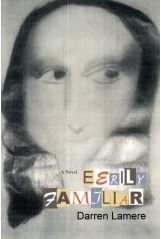
REVIEW: Eerily Familiar by Darren Lamere

EerilyFamilarCover.jpgPLOT

Tom Morrow awakes to a message on his bedside pad. It says that Raquel, who was murdered three years ago, is still alive. And it appears to be in Tom's own handwriting.

When Tom goes to visit Raquel's grave, someone is already there. Someone who looks a lot like Tom. Someone who, unlike Tom, remembered to bring a boombox to play Tom and Raquel's song.

More than just his girlfriend, Raquel was -- and remains -- the center of Tom's world. So Tom needs to figure out what is going on. Especially when her doppelgänger shows up as well.

But each step is accompanied by a profound sense of déjà vu. Back to three years ago. When Tom first investigated the truth behind Raquel's death . . . .

MY TAKE

Eerily Familiar is smart. The first half of the novel captures the reader in its baffling, David Lynch-style universe as Tom -- both in the present and, in alternating chapters, three years in the past -- investigates Raquel's death. But unlike many novels that rely upon cryptic happenings for their plots, first-time author Darren Lamere actually plays fair: halfway through, he explains the peculiar happenings, in a way that makes sense and is consistent with everything we've read so far.

What makes this impressive is that the explanation in no way diminishes the remainder of the story. Often, when a novel or movie depends upon apparently inexplicable circumstances to drive the plot, the story can no longer sustain interest once the explanation is revealed. The moment that Tom uncovers the truth, I braced myself for the novel to lose its enjoyably enigmatic tone.

In fact, Eerily Familiar only becomes richer. The explanation of one mystery branches off into several new complications, and the full implications of the situation are thoroughly explored. With each development, Lamere treats the reader fairly and with unbending intelligence, as what we thought we knew reconfigures itself to incorporate ever more intriguing situations. Yet throughout this process Lamere's first person narration remains impressively clear, so that, as confounding as events may become, we never have any difficulty in following the story.

Unfortunately, despite its prodigious strengths, Eerily Familiar is a little too bloodless to be fully engrossing. Although my mind was constantly entertained, the novel fails to achieve equal emotional heights. Events occur that should be extremely poignant, and, indeed, Tom duly talks about his inner upheaval. Yet Tom never really comes alive for the reader, and so his pain does not effectively translate into a shared emotional response. Lamere is clearly an extremely skilled writer, and he does wonders marshaling his detailed plot into a coherent, entertaining whole. My only hope -- and my genuine expectation -- is that next time, his characters will be as fully developed.

P.S.: This is a minor point, but cute names are almost always distracting. "Tom Morrow" is no exception, and is the one place where I felt Lamere was trying to be too clever.

AVAILABILITY

Eerily Familiar is available from iUniverse or Amazon as a $19.95 paperback, a $29.95 hardcover, or a $6.00 DRM encrusted Adobe ebook. As far as I can tell, Lamere does not maintain an author website.

BONUS RECOMMENDATION

Eerily Familiar's chilly conceptual intensity reminds me a lot of Primer, the $7,000 indie film from 2004 that reduced the mysteries of time travel to a simultaneously baffling yet workaday reality. Primer, like, Eerily Familiar, thoroughly engaged my mind, and was genuinely worthwhile for that reason alone, but ultimately failed to fully progress beyond being an extremely clever intellectual exercise to become emotionally involving as well.

Saturday, March 08, 2008

REVIEW: Perchance to Feast by Ellen Belitsky

PerchanceToFeast(S).jpgPLOT

Sixty years ago, the cosmic imp Chance, in his eternal quest for entertainment, set a scheme in motion. He contrived to inspire Sadie and Lillian, best friends at Hometown Junior High, to write the story of Subring, a hellish realm where the mean girls who bullied them would be punished. Scared of their own creation, the girls quickly abandon the story. But dark ideas, once loosed, are not always easily buried.

Now, decades later, Chance is ready for the grand amusement to begin. A new generation of Hometown residents, including Sadie's own granddaughter, have been set in motion and are ready to assume their roles. And Subring is ready to be unlocked.

MY TAKE

I expected the worst from Perchance to Feast. The back cover description seemed to promise a twee fairy tale. Based upon my own prejudices, the author bio (Ms. Belitsky describes herself as a "retired teacher" who "is passionate about peace, the environment, the Bill of Rights and all things built of words") appeared even worse. I knew I was being unfair, but what could a retired teacher have to say to someone as jaded as me? And the first few pages -- told from Chance's point of view -- heightened my fears. They struck me as overwritten, filled with alienating alliteration and the typical "look at the superior cosmic being who happens to find amusement in playing with humans" clichés that I have seen so many times before.

And, to be honest, Perchance to Feast does lack a certain professional polish that betrays its POD origins. The (thankfully few) passages told from Chance's perspective continue to be heavy-handed. Similarly, Sadie's dialogue, filled with "Oy!"s and noun-verb inversions, is less colorful than it is a caricature (she is a Russian immigrant). And Ms. Belitsky's decision to use on-the-nose names for places and off-stage characters (the novel takes place in "Hometown," which is home to both "Hometown Junior High" and snooty "Classical Academy;" "Mr. Cleanitup" is the janitor, while "Mrs. Fuddydud" and "Mrs. Stickler" are teachers) is not so much clever as evidence that Ms. Belitsky was trying too hard.

But my reservations soon fell away, and I suddenly realized that I was truly enjoying Perchance to Feast . The novel quickly hit its stride once the POV shifted from Chance to other characters and the story began to unfold. Yes, the novel is essentially a fairy tale about a brave young girl foiling the plans of a grotesque evil queen. However, Perchance to Feast is anything but twee. The story is surprisingly dark, mature and involving. Although Subring does not open its doors until the last portion of the book, Ms. Belitsky holds our interest throughout with an interesting backstory and a slowly escalating tension, with a fully satisfying resolution.

Indeed, the many successes of Perchance to Feast easily overcome its few stylistic failings. In particular, Ms. Belitsky's handling of one of the novel's underlying themes -- how stories impact our lives -- is impressively graceful. Novels dealing with "the power of the imagination" are often uncomfortably blunt and, quite frankly, unimaginative. But Perchance to Feast handles this theme deftly. The novel may not exactly be subtle; after all, the premise of the novel is that Chance has manipulated the cosmos so that the imaginary Subring will intrude on the real world. But Ms. Belitsky's handling of this subject is elegant and low-key, allowing the theme to play out naturally and without becoming overbearing.

Ultimately, however, it is Ms. Belitsky's handling of her characters that is particularly accomplished. The more "down to earth" characters, such as Lillian (an elderly woman for most of the novel) and Sadie's grand-daughter Karma Robin (a thirteen year old who likes to be called K-Rob) all feel genuine, despite the range in their ages and personalities. The more "extreme" characters such as the villainous Hera, the drama teacher at Classical Academy, are so (entertainingly) monstrous as to be almost inhuman. Yet both types of character work well on their own and, impressively, this contrast does not tear the novel apart. Perhaps the ability of these disparate characters to co-exist is due to Ms. Belitsky's decision to keep them apart for most of the novel, until the situation is so out-of-control that the mashing of the ordinary and the extreme seems reasonable. Or perhaps it is because Ms. Belitsky succeeds in giving us just enough background detail about even the monsters so that, ultimately, they don't seem quite so inhuman after all.

AVAILABILITY

Perchance to Feast is available for $15.95 from iUniverse or Amazon. (As always, iUniverse has a free preview of several pages available.) Ms. Belitsky writes a blog about the novel called Perchance to Publish; she has written several interesting posts about the benefits and frustrations of publishing through iUniverse, including a couple that reveal how such an interesting novel ended up with such an uninspiring cover.

BONUS RECOMMENDATION

Extraordinary(s).jpgBack during the initial run of this blog, John Purlia sent me a review copy of his novel The Extraordinary Adventures of the 25 Year Old Birthday Muse (available from Lulu through a special link available on request from the author). I didn't review it at the time because I didn't know quite what to say. In large part, I still don't.

Extraordinary Adventures is an episodic fairy tale about Kathy, muse of Gardening, Fashion and Photography, who wishes on her twenty-fifth birthday to "finally find the artist whom I shall inspire." She is immediately cast from Olympus in order that she might better chase her dream. What follows is a series of agreeable encounters with quirky people and places (illustrated by full-color reproductions of masterpieces of mythologically inspired art), events that, while individually interesting, lack conflict or narrative drive. I enjoyed Extraordinary Adventures, the same way one might enjoy a languorous stroll through a local art museum on a hot afternoon: a pleasant diversion to be sure, and worthwhile in its understated charms, but, ultimately, not fully inspiring.

Friday, January 19, 2007

REVIEW: Bass Desires by DJ Lufkin

PLOT

Jude Barnes is nearing forty. His music career has gone nowhere, his trust fund is almost depleted, and Rachel, his wife, thinks that it's time for him to get a "real" job.

But Jude has just met Nerfertiti. Nefertiti can sing. Her talent could even push Jude's little bar band into the big leagues. If Jude can convince her to stay with the band. And if Jude wants to stay himself.

MY TAKE

Jude Barnes is kind of a jerk. And that's what makes Bass Desires interesting.

DJ Lufkin is a proficient writer, and Bass Desires is an enjoyable read with a brisk narrative flow. The problem is that the reader can predict the entire plot from the back cover blurb. A beleaguered hero, searching for that one last chance to fulfill his dreams, will overcome both his materialistic wife and a soul-numbing white-collar career opportunity to find musical, spiritual and maybe even romantic fulfillment with a new muse. And so the novel goes. Indeed, Jude and Nefertiti's relationship, while well written, is the least involving part of the tale.

However, Lufkin has an uncommon and welcome perspective on Jude's relationship with Rachel. Jude is not a wholly sympathetic hero: he has cheated on his wife in the past, and seems a bit too willing to do it again. Nor is Rachel wholly unsympathetic: Lufkin displays some empathy, or at least understanding, for her desire to live a more comfortable life after struggling through years of Jude's pursuit of a music career (and other women).

Perhaps most interesting is Jude's response when Rachel forces him to attend a motivational seminar. The speaker advises that sometimes one has to place one's own dreams above all else, even if it means leaving other people behind. Jude is disdainful of this trite aphorism, recognizing that it justifies both Rachel's desire to move into middle-class respectability and his own desire to continue to pursue his musical goals. In other words, it solves absolutely nothing. But at the same time, Jude seems to understand that his desires are not better than Rachel's, just different. He has sympathy for Rachel even as he chooses to pursue his own wants and objectives and their relationship teeters on collapse, a tension that persists to the end of the novel.

Or rather, I think that tension exists. To be honest, the shadings are subtle. I wonder if I'm seeing things that aren't there. Despite what I've said, Lufkin still portrays Rachel as a bit too shrewish. And he stacks the deck against Jude's potential new career as an investment advisor by not only making his workplace stressful and boring but also outright corrupt, which makes Jude's choice to reject that lifestyle much less interesting. Moreover, Lufkin doesn't really explore the difficult question of whether, at some point as the years fly past, it becomes unreasonable to continue to devote all of one's time to pursuing an artistic dream.

To the extent I'm correct about Lufkin's intent, I appreciate his efforts at giving his characters depth and balance. But I wish he had gone a little bit further in that direction.

AVAILABILITY

Bass Desires is available in paperback for $14.95 from iUniverse or Amazon, or as an Adobe eBook (a restricted-use format that I adamantly oppose) for $6.00. DJ Lufkin has both a dedicated website and a MySpace page for the novel; however, neither provides any substantive content beyond advertising the book's existence.

BONUS RECOMMENDATION

Dreams don't always come true. Genuinely talented artists give up every day without achieving any recognition or success in their chosen field. I mourn the passing of Cubic Feet, a splendid powerpop band that never garnered much attention and, as far as I can tell, called it quits by 2002. Although the band is no more, all four of their albums remain available on CDBaby, including the exemplary Passenger in Time. Should CDBaby ever sell out its stock, three of the four albums (including Passenger in Time) are also available at iTunes, albeit encrusted with iTunes DRM (which, as I've mentioned before, drives me crazy). Unfortunately, Cubic Feet's albums are not available for download at either of the non-DRM legal download sites I frequent (eMusic and MP3tunes).

Wednesday, January 03, 2007

REVIEW: Every Sigh, The End by Jason S. Hornsby

PLOT

Ross Orringer is bored with it all: his job, his friends, his family.

But if his life is so pointless, why are cameramen recording his every move?

Then the zombies show up. And the world turns out to be much more complicated than Ross ever suspected.

MY TAKE

I enjoy encountering the profound: that rush of thought, that churning of the imagination and gut, that feeling, if only for an instant, of connecting with something grander than oneself. There is no single type of narrative that can move me in this way. A poignant moment in the simplest of narratives can reveal great truths.

At the same time, even stories that I don't fully understand can give me this rush. I have my limits: I lose interest if a novel is too abstract, abstruse or surreal. But a little mystery and uncertainty can be exceedingly powerful. Perhaps I'm just fooling myself in these instances; perhaps the author has only dazzled me with style, and there is no substance hidden underneath. But such concerns are largely irrelevant. Awe, like fear and mirth, is an emotion. It is real if I feel it to be real. Perhaps I am shallow, but sometimes I don't care whether I've actually learned anything, so long as an author makes me feel like he is saying something important. That feeling can itself be a worthwhile experience.

With that understanding, Jason Hornsby's Every Sigh, The End may be the best zombie novel I have read. And no, I don't mean to damn with faint praise. So let me rephrase that: Every Sigh is a fine novel, period.

To be sure, Every Sigh is well-written. The atmosphere is tense. The characters are real. Ross Orringer may be an annoyingly passive and obnoxious protagonist at the start of the novel, but we come to understand him as he faces situations way beyond his (and our) experience. The build-up to the zombies -- just one element of a much broader horror -- is slow, but compelling. When the zombies actually appear, they have context, and that makes them all the scarier.

However, what makes Every Sigh stand out is the impression of significance. It feels like a grand truth is peeking through the enigmatic and conspiratorial fog that suffuses the novel. It all seems to mean something.

Now, to be honest, I'm not really sure what that "something" is. Every Sigh's secrets are never fully revealed. Where I see glimmers of profundity, others, perhaps rightly, may see empty posturing. But I think Hornsby handles his enigmatic narrative just right. The story feels epic. The ending feels satisfying. And I like that the mysteries underlying the novel are never fully explained. Too much exposition can transform the mysterious and compelling into the mundane and silly. Hornsby answers enough questions to sate the reader. But he knows when to step back and let the reader's imagination finish the job.

AVAILABILITY

Every Sigh, The End is available through iUniverse and Amazon. Jason Hornsby presently does not have a personal website, although I suspect that, as often is the case with POD zombie novels, Every Sigh's audience will find it regardless.

BONUS RECOMMENDATION

Greg Stones paints watercolors. Some of his paintings depict surreal juxtapositions of fanciful characters; others are more contemplative. While I like them all, I have a particular soft spot for Stones' zombie paintings. I proudly display this fine piece in my home:


And best of all, the print only cost $20. I encourage you to check out Stones' website for yourself; in addition to this print, there are several other worthwhile zombie (and non-zombie) paintings and prints available for purchase.

Saturday, December 23, 2006

REVIEW: Enola's Wedding by Jack Mauro

PLOT

An unprovoked bee sting hobbles Enola Tyrwhitt. Drew Morrigan, ever the gallant knight (and, in this instance, the noble steed as well) comes to her rescue, sweeping Enola off her feet and carrying her to safety.

After so romantic a first encounter, what choice do Enola and Drew have but to wed?

In ways both profound and minute, Enola and Drew's engagement reverberates far beyond the happy couple. As does Enola's slow realization that, just maybe, she and Drew are not quite soul-mates after all.

MY TAKE

Enola’s Wedding tells several love stories. It tells of love amongst friends, family, and lovers; of love that is returned and that is unrequited; that redeems and that demeans; that persists and that withers.

Contrary to the common edict, Mauro often tells rather than shows. He does simply recount his characters' actions and thoughts. Rather, he comments and philosophizes, observes and contradicts, editorializes and explores. Mauro’s narration dominates the tale.

This approach has its risks. Such an idiosyncratic style can easily descend into irritating self-parody if not handled with consummate skill. Indeed, Mauro’s characters initially wilt into an undifferentiated mass in the shadow of his overwhelming personality.

However, Mauro proves more than equal to the challenge. His writing is, quite simply, glorious. His voice is insightful, funny, and captivating. He swoops in and out of characters’ thoughts, histories and feelings, and then darts into illuminating analogies, reflections and homilies. The reader may constantly be aware of Mauro as narrator. But Mauro understands his characters too well, and talks about them too vividly, for them not to develop as full and sympathetic individuals.

Nor does Mauro's inventiveness hide his fundamental compassion for his characters. This empathy does more than soften Mauro’s often arch tone. It elevates Enola’s Wedding from being a mere stylistic showpiece into being a truly moving, wonderful meditation on the manifold nature of love.

AVAILABILITY

Enola's Wedding is available through iUniverse and Amazon, as is Jack Mauro's stylistically similar, and equally wonderful, Spite Hall. Mauro’s decision to publish through iUniverse is fortuitous; as I discussed here, iUniverse allows customers to preview the books it publishes, so you can check out Mauro’s writing before laying down your money to confirm whether you find it as enthralling as I do.

Additional information about Mauro is available on his homepage, although as of this writing its current focus is Mauro's upcoming guide to online dating (due to be published by Simon & Schuster in 2007). I wish Mauro the best of luck with this book, but must admit I hope he returns to fiction one day.

BONUS RECOMMENDATION

David W. Jacobsen is a singer-songwriter with a distinctive voice, both in terms of his vocals and his compositions. Jacobsen’s quirky edge sets him apart even when addressing well-worn matters of romance and loss. His virtues come to the fore on The Chasm.

As Jacobsen notes on his website, The Chasm is “about the gap between people who are trying to connect.” While a bit overlong, the album is a fine tribute to the humor and pain of love. Among several highlights, “Jacqueline” beautifully elegizes a relationship that cowardice killed before it could even begin; “Dry Spell” is a humorous folk mock-anthem about Jacobsen's solidarity as “one of many not getting any” (sex, that is); and album-opener “10,000 feet” rages, in a polite folk-rock way, about a woman trying so hard to be special that she isolates herself from the man who is trying to treasure her.

The Chasm, as well as other Jacobsen albums, is available for purchase on CD from CDBaby, or as MP3 downloads from eMusic, or, if you don't mind being subject to Apple's DRM restrictions (which I personally find abhorrent), from iTunes. Just like iUniverse, all of these sites offer previews, so you can sample Jacobsen's voice before you buy.

Thursday, December 07, 2006

REVIEW: Sway by Mike Preston

PLOT

Stan Johnson has never connected with another human being. And that’s fine with him. Stan just wants to be left alone. He buys a small house in the middle of nowhere to pursue this dream.

But Stan’s new home comes with a companion: the spirit of a primitive (and not very bright) warrior. The ghost (who Stan calls Tonto) likes loud noises. He likes watching bad television. He likes starting fights.

In short, Stan and Tonto have nothing in common. But Tonto won’t go away.

Now on death row, Stan recounts the story of their relationship – and its murderous consequences.

MY TAKE

Sway is a twisted update of the old “Little Miss Marker” (or “Punky Brewster”) story. Traditionally, an adorable child redeems a grumpy recluse through the gift of love. Here, the "adorable child" role is filled by a slovenly, loud, and violent (not to mention hirsute) ghost. And rather than an appreciation for life, the characters’ relationship leads to serial murder and animal mutilation.

Surprisingly, the story remains as heartwarming as ever.

Sway is a comedy, which is fortunate. A novel about an unemotional recluse, a petulant ghost, and the murder of the people who come between them, shouldn’t take itself too seriously. Mike Preston, a stand-up comedian, succeeds in pulling a lot of laughs out of the escalating disasters that result from Tonto’s invasion of Stan’s world.

However, Sway is also a love story. Actually, it is two love stories, one platonic and one romantic. First there is the relationship between Stan and Tonto. As improbable as it may sound, the story of how these two lonely souls, who cannot even communicate with each other, learn to value companionship over continued isolation, is genuinely moving. Second, there is the story of Stan’s burgeoning affair with the checkout woman at his supermarket. Sway is funny, to be sure. But the novel is most memorable for these relationships, and for Stan’s growing realization that he does not want to remain isolated.

WRITING

Sway’s tone is somewhat inconsistent. For the most part, Preston’s humor blends well with the story of Stan’s two relationships. However, the slapstick (or attempted satire) of the novel’s framing device, in which Stan is hustled by his incompetent death row attorney, is jarring. (As an aside, I realize this is a nitpick, but no one in the United States goes from trial to actual execution within a matter of weeks.) Moreover, although the murder victims are generally unsympathetic, the deaths, though essential to the plot, still stick out a bit awkwardly. Nonetheless, I enjoyed Preston’s relaxed and conversational style, and do not hesitate to recommend the novel as a whole.

AVAILABILITY

Sway is available from iUniverse (and Amazon). As far as I can tell, Mike Preston does not have his own website, although a small amount of information about him is available here.

BONUS RECOMMENDATION

“Miserable Girl” by I Hate This Place is a bouncy synthpop ode to two miserable, misanthropic people coming together to form a somewhat less miserable union. The song never fails to cheer me up. It is available on iTunes on the One More Minute album (which can also be bought in its entirety on CDBaby).

Wednesday, November 29, 2006

Why I Like -- And Hate -- Shopping At iUniverse

iUniverse POD books are particularly well-represented on my bookshelf. It’s not that iUniverse authors are uniquely talented. Every POD publisher has a few great books, and a whole lot of dross. It's certainly not that iUniverse produces an especially beautiful physical product. iUniverse's cover art is as unforntunate as any POD publisher's.

Rather, I like iUniverse because it allows me to read several pages of the books I'm interested in before I purchase them. Other POD websites offer less extensive preview functionality. For example, Lulu (which I also really like, and which will be the subject of a future post) recently began providing pages from most (but not all) of its newer offerings. AuthorHouse sometimes provides a few random paragraphs. But iUniverse lets you check out the first several pages of all of its books.

This obviously does not advantage every iUniverse author. I've often passed on a book that initially looked intriguing after I've read the first few pages (or sentences). However, the fact that iUniverse gives me the opportunity to make this assessment is what makes me willing to buy its books at all. If I bought every POD book that caught my eye without further investigation, I'd be broke (and my house would be filled with awful fiction).

However, as much as I appreciate iUniverse's preview policy, its absurd e-book policy drives me crazy. Because POD paperbacks are expensive, I only buy a novel if I am very confident that I will enjoy it. However, I would be happy to take chances on more novels, ones that I am not quite as certain about, if I could purchase them in the cheaper e-book format.

In this regard, ordinary pdf e-books are convenient: they can be printed, read by a variety of software on a variety of systems, and freely transferred between all of my computers and handheld devices. Indeed, several POD publishers (like Lulu) distribute their e-books in basic pdf format.

Unfortunately, all of iUniverse's e-books are sold in Adobe Ebook format. Adobe Ebooks cannot be printed, which is a huge inconvenience for me. Moreover, Adobe EBooks can only be read using Adobe's own proprietary Reader software. The Adobe Reader must be installed and registered on every computer or device on which you want to read your Ebooks. If Adobe doesn't make a reader for your device, you're out of luck. If you buy an Adobe Ebook but then change your system someday so that the Adobe Reader no longer works or is not available, your investment is gone. You can never read your EBook again.

This is unacceptable. Why shouldn't I be able to print my e-books to read in the bathtub? Why shouldn't I be able to read my e-books on any program I want, and on any computer I want, without registering my every move with Adobe? Why should I have to worry about someday losing access to my EBooks altogether? Is iUniverse really that afraid of POD e-book piracy? I'm as big a POD novel booster as there is, and I truly believe that some POD novels are as good as any contemporary popular fiction. But let's be honest: the demand for these books in the black-market underground just isn't that great. All that iUniverse has succeeded in doing is alienating me and reducing its own sales.

Sunday, November 26, 2006

REVIEW: Roll! They Cried by Soren Narnia

PLOT

Years ago, pro baseball player Ben “The Blemish” Glinton disgraced himself through a particularly boneheaded performance during game seven of the World Series. Broke and humiliated, Ben now seeks to recapture fame and fortune by staging -- and winning -- a national tabletop "baseball" simulation championship. Accompanied by his biographer (who is seeking an explanation for Ben's foul-ups all those years ago) and the members of his tabletop baseball club (including a three-time Pulitzer-prize winning novelist and a twelve year old genius), Ben sets off on his cross-country quest, with glory, redemption, and $19,450 of his own money on the line.

MY TAKE

This is a very funny book. A slapstick buddy film in novel form, Roll! They Cried is consistently good-natured and high-spirited (and would, in fact, make an outstanding film). The humor may be broad, but Soren Narnia carries it off with wit and style. Not only are the jokes easy and unforced, but, impressively for this type of narrative, Narnia also tells a real story, with real characters (broad characters, but characters nonetheless) and a satisfying third act. Roll! They Cried may not be profound – indeed, it actively mocks profundity at several points – but it embodies “wacky hijinks” done right, and there’s nothing wrong with that.

A final word for non-sports-fans: don’t be put off by the baseball framework. No one could care less about baseball than me, but it truly is only a framing device, and enjoyment of the novel does not depend upon an appreciation of (or extensive knowledge about) baseball.

WRITING

Narnia's writing is thoroughly professional. Stylistically, Narnia writes with confidence and maintains a consistent, light-hearted tone throughout the book. Editorially, Roll! They Cried is equally accomplished. The iUniverse print version of the novel is a tight and satisfying 173 pages. There are no loose ends or extraneous characters or plotlines, and typos are extremely minimal. Narnia’s proficiency is perhaps unsurprising: he is a prolific, experienced author, with at least twelve other POD titles (in a variety of genres) to his credit. That experience shows here.

AVAILABILITY

Roll! They Cried, like most of Narnia's works, is available as of this writing for free at his website. If you like what you're reading after the first few chapters, I encourage you to support Narnia’s efforts (as I did) by buying a copy of the book through iUniverse or Amazon.

BONUS RECOMMENDATION

I am not a baseball fan but enjoyed Roll! They Cried tremendously. Similarly, I am not a jazz fan, but am a huge fan of Elvis Sinatra's off-kilter -- but thoroughly professional -- pop-jazz-vocal compositions, all of which are available as of this writing for free download from his website. Whether singing about the plight of us exceptionally attractive men (“Handsome Guys”) or about a man in love with a fish (“Pisces”), Elvis Sinatra has the musical and vocal chops of a serious Sinatra (Frank, that is) style musician combined with the wit of Dorothy Parker and the playful darkness of Lemony Snicket.