 Tom Lichtenberg writes curiously engaging novellas. His stories are not driven by action but by mood and metaphysics. His premises often begin with fairly standard, often vaguely science-fiction concepts: time travel in Time Zone, for example, or mind control in World Weary Avengers. But he spins those concepts out into melancholy, thoughtful tales.
Lichtenberg cares little about the mechanics of the MacGuffins that underlie his stories. Rather, he explores the emotion and (often) dislocation that people feel when confronted by something outside their normal experience. In Somebody Somewhere that "something" is as commonplace (relatively speaking) as a kidnapping and hostage situation; in Time Zone, as noted above, the "something" is as vast an incomprehensible as travel through time. Lichtenberg's characters may adapt to the situation or ignore it, or become totally overwhelmed; but the true story is always in those emotions and responses, rather than the rote turnings of some formulaic plot device. Although Lichtenberg's spare, quiet style could not be more different than H.P. Lovecraft's ornate verbal extravagance, the two share a conceptual interest in exploring how people respond when conventional reality is stripped away.
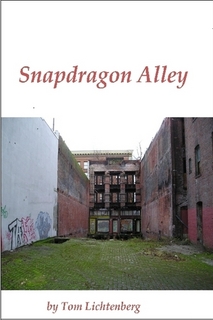
Lichtenberg's prose in some of his novellas ranges pretty far into the experimental; although I have enjoyed some of these, my admitted preference is for those works that hew a bit closer to a traditional narrative style. My favorite thus far is Snapdragon Alley, the story of young friends who discover a vacant lot at the end of a bus line that, perhaps, is more than it seems.
Lichtenberg's "launching point" for Snapdragon Alley is nothing new (Lichtenberg himself gives away in his back-cover blurb that, in investigating the lot, the children "encounter the possibility of" a gateway to "another dimension"). Nor, despite some interesting narrative quirks along the way, are the bare facts of how the story plays out particularly novel. But Lichtenberg captures beautifully the poetry of what such a gateway might mean to the people who stumble across it, and the emotions it might inspire. There are no loud explosions in Snapdragon Alley, or, indeed, very much overt action at all. But the novella, like much of Lichtenberg's writing, inspires an appreciation of just how vast, mysterious and majestic "reality" is, and that is both a far tougher task and a greater triumph.
Lichtenberg recently made several of his novellas (including Snapdragon Alley and all of the others mentioned above) available for free on Smashwords. (He also maintains a complete index of all of his works, including a link for free webpage reading of each and additional links for download sources, here.) Beyond Snapdragon Alley, other recommendations include Orange Car With Stripes (described by Lichtenberg as an "atheist science fiction comedy," as good a description as any) and, on the slightly more experimental side, the aforementioned Time Zone. However, all of Lichtenberg's novellas are quick reads and well worth checking out.


 Howard McKay isn't really a superhero. He doesn't have any superpowers. In fact, he's a fat alcoholic, who only dresses up in a fluorescent yellow body suit (complete with pink running shorts and boots) because of an unfortunate incident in which he mooned a judge during a drunken romp through the park. As his punishment, the vindictive judge sentenced Howard to an even more unfortunate community service sentence: to patrol the city streets as a citizen watchdog, while dressed in the rather unique aforementioned ensemble.
 Laura "Keepsie" Branson is in the Third Wave of people born with superpowers: anyone who tries to steal from her gets frozen in place. A few years ago, her power was judged inadequate, and her application to train with the First and Second Wavers at the Seventh City hero Academy rejected. So now Keepsie quietly runs her bar, catering to her minor-league peers. Until she suddenly finds herself at the center of an epic battle between the mightiest heroes and villains of Seventh City, and Keepsie and her friends discover that it is up to them to save the day -- if they can figure out whose side they're really on.