Wednesday, March 19, 2008

FreeBooks #9: Playing for Keeps by Mur Lafferty

PfK.jpgLaura "Keepsie" Branson is in the Third Wave of people born with superpowers: anyone who tries to steal from her gets frozen in place. A few years ago, her power was judged inadequate, and her application to train with the First and Second Wavers at the Seventh City hero Academy rejected. So now Keepsie quietly runs her bar, catering to her minor-league peers. Until she suddenly finds herself at the center of an epic battle between the mightiest heroes and villains of Seventh City, and Keepsie and her friends discover that it is up to them to save the day -- if they can figure out whose side they're really on.

Mur Lafferty's Playing for Keeps is an intriguing but imperfect effort. Lafferty is a clearly a talented writer, and her colloquial style, appealing common-folk (if superpowered) protagonists and skill with action scenes go a long way towards holding the reader's interest. The story, however, does not feel fully developed. The novel is paced a little oddly, with Keepsie and her friends doing a lot of running about that doesn't seem to advance the plot. The motivations of both the "heroes" and "villains" that Keepsie must confront are at times unclear, and their characterizations feel similarly inconsistent. Nonetheless, Playing for Keeps shows tremendous promise both in its writing and its basic premise, and, given the near-cliffhanger nature of the book's conclusion, we will hopefully see more, better-realized adventures of Keepsie and her crew.

Playing for Keeps is available in several different formats, including as a free download (or a $16.99 paperback) from Lulu or as a free audiobook from PodioBooks. Check out the very thorough Playing for Keeps website for other options and extras; Lafferty also maintains a general website here.

Sunday, March 16, 2008

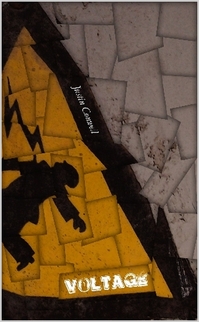
REVIEW: Voltage by Justin Conwell

Voltage.jpgPLOT

After attempting suicide, Eric had his self-destructive thoughts blasted out of his head through Electro-Convulsive Therapy. Unfortunately, the therapy also stole his memory of what drove him to suicide in the first place. Even worse, it tore away the creative part of Eric's brain, leaving the former painter without the inspiration to do much more than work as a clerk at the local discount store.

Now a year has passed, and Eric's daily routine is upended when the latest load of donations includes a box filled with ashes and labeled "Harold." Pressed into a road trip to bring Harold's remains back home, Eric finds himself forced to confront both his current life and the past that got him there.

MY TAKE

Over a year ago, I wrote a brief review of Saints Visible by "Justin Gil." I described the novel as a "charming, folksy tale" with considerable "laid back charms," although I found the resolution to be "rather abrupt" and "too easy."

I have been told that Voltage, attributed to a "Justin Conwell," is in fact the same author's second novel. Based on the evidence of the two books, I certainly believe it. Voltage demonstrates the same strengths as Saints Visible: a clear, inviting writing style that immediately draws the reader in. Voltage, however, is a considerably greater triumph, as it marries those strengths to a much more mature and involving story.

With its themes of suicide and long-buried memories, the novel may sound exceedingly glum or melodramatic. And indeed, as one might expect, Eric's buried memories do conceal a tragic story that ultimately impact his present as much as his past. However, Voltage is not a melodrama. Rather, Voltage is a tragedy, in the most positive (if not quite Grecian) sense of that word.

Like any good tragic hero, Eric is both deeply flawed -- indeed, infuriating at times -- but also deeply, recognizably human. Conwell draws us into Eric's tale slowly; although dark rumblings can be heard from the start, the early part of the book is fairly relaxed, and even whimsical. But as the story progresses, we grow to care about Eric and his traveling companions (including romantic interests both actual and potential). When Eric's failings and history inexorably surface, there is nothing flashy or over-the-top about the results; everything in Voltage feels real, and plausible. And this quiet power makes Eric's journey all the more affecting.

Indeed, by the end of the novel Eric and his friends have all learned, in one way or another, that you cannot run away from your past. This is, of course, an ancient literary theme, dating back (at least) to the aforementioned classical Greek tragedies. Yet Voltage distinguishes itself through compelling characters that make its exploration of this well-worn trope feel fresh, powerful, and, ultimately, heartrending. Saints Visible was worthwhile as a cute "feel good" book; Voltage, by contrast, is a genuine work of art.

AVAILABILITY

Voltage is available from Lulu here as either a $0.50 download or an $11.99 paperback. Saints Visible is also still available from Lulu, either as a free download or an $8.56 paperback. The author does not appear to have a website; nor am I aware of any other books he may have written, whether as Justin Gil, Justin Conwell, or some other pen-name.

BONUS RECOMMENDATION

The Sheds have made all four of their folksy rural rock albums available for free download, and I strongly recommend that you take them up on their generosity. Each is strong, but the most recent two -- The Sheds Quit Smoking and You've Got A Light -- are especially stunning. The Sheds sing about the small issues of day-to-day living, and, appropriately enough, their songs encompass the gentle humor, quiet yearning, and upbeat joys of everyday life, while also maintaining a consistent and intense melodiousness. These guys should not be missed.

Sunday, March 09, 2008

FreeBooks #8: Deadolescence by Robert Devereaux

Robert Devereaux's Deadolescence (A Tale of Love and Sacrifice) is a slippery customer. The story is set in the Demented States of America, where violence is a way of life and decent people live in threesomes (so long as the threesomes are mixed-gender; after all, same-sex threesomes are just wrong). To prepare them for the rigors of adulthood, high school seniors undergo a deadly prom night rite of passage: one couple is picked at random to be slaughtered by a designated slasher, chosen from the ranks of the high school faculty. This year, however, something has gone very wrong at Corundum High. And a lot more than one couple's blood is going to be spilled. . . .

At first, everything about Deadolescence seems too blunt. The satire is obvious: the President of the Demented States of America is a literal puppet, for goodness' sake. The violence (and there is a lot of it) is graphic, gory and extreme. So is the sex; there is stuff going on with piercings and zippers that I really don't want to think about any more. Be warned: this book is not for the squeamish.

But once I acclimated to the excess (more or less; the finale takes it up another notch and truly made me squirm), I was able to appreciate the novel's considerable strengths as well. The story as a whole is smartly paced and plotted, with an effective conclusion that thoughtfully, if gruesomely, caps all that came before. There are also tinges of subtlety and humor amidst the novel's extremes, whether in the amusing portrayal of anti-government crusaders or in the more quiet moments of genuine fear, such as when a young girl must hide in a closet while unspeakable things go on outside.

Perhaps the most surprising -- and ultimately telling -- aspect of Deadolescence is how much we come to empathize with, or at least understand, the students, teachers and parents of Corundum High. Violence and the infliction of pain are fundamental parts of life in the Demented States of America. The characters who inhabit that world, naturally enough, largely tolerate (and even endorse) the society in which they have always lived. As a result, they accept and do things that we, as readers in the United States of America, might (and hopefully do) find barbarous. Yet even if we don't always agree with their worldview, we can at least begin to understand it, given the context in which it developed. Despite our profound differences in values, we can even relate a little bit, as we wonder how we would behave if we grew up in their world.

I don't mean to make too much out of Deadolescence. It is, in essence, a slasher film in novel form. But as such things go, it is an especially fine and intelligent slasher film. It is filled with effective gore, real frights, and good characters, is thoughtful enough to have real substance, and is great fun to boot.

As of this writing, Deadolescence is available for free at the author's website. Grab it while you can; Devereaux has promised to try to bring the book to print, either from a traditional publisher or, if necessary, POD. (And I must say, in the event that you don't read this until after the novel is no longer available for free: if you can stomach extreme horror, Deadolesence is well worth paying for). For more graphic violence-and-sex fun, this time set in a world where Santa Claus and fairy tales are real, check out Devereaux's equally extreme Santa Steps Out, published by Leisure Books and available used on Amazon.

Saturday, March 08, 2008

REVIEW: Perchance to Feast by Ellen Belitsky

PerchanceToFeast(S).jpgPLOT

Sixty years ago, the cosmic imp Chance, in his eternal quest for entertainment, set a scheme in motion. He contrived to inspire Sadie and Lillian, best friends at Hometown Junior High, to write the story of Subring, a hellish realm where the mean girls who bullied them would be punished. Scared of their own creation, the girls quickly abandon the story. But dark ideas, once loosed, are not always easily buried.

Now, decades later, Chance is ready for the grand amusement to begin. A new generation of Hometown residents, including Sadie's own granddaughter, have been set in motion and are ready to assume their roles. And Subring is ready to be unlocked.

MY TAKE

I expected the worst from Perchance to Feast. The back cover description seemed to promise a twee fairy tale. Based upon my own prejudices, the author bio (Ms. Belitsky describes herself as a "retired teacher" who "is passionate about peace, the environment, the Bill of Rights and all things built of words") appeared even worse. I knew I was being unfair, but what could a retired teacher have to say to someone as jaded as me? And the first few pages -- told from Chance's point of view -- heightened my fears. They struck me as overwritten, filled with alienating alliteration and the typical "look at the superior cosmic being who happens to find amusement in playing with humans" clichés that I have seen so many times before.

And, to be honest, Perchance to Feast does lack a certain professional polish that betrays its POD origins. The (thankfully few) passages told from Chance's perspective continue to be heavy-handed. Similarly, Sadie's dialogue, filled with "Oy!"s and noun-verb inversions, is less colorful than it is a caricature (she is a Russian immigrant). And Ms. Belitsky's decision to use on-the-nose names for places and off-stage characters (the novel takes place in "Hometown," which is home to both "Hometown Junior High" and snooty "Classical Academy;" "Mr. Cleanitup" is the janitor, while "Mrs. Fuddydud" and "Mrs. Stickler" are teachers) is not so much clever as evidence that Ms. Belitsky was trying too hard.

But my reservations soon fell away, and I suddenly realized that I was truly enjoying Perchance to Feast . The novel quickly hit its stride once the POV shifted from Chance to other characters and the story began to unfold. Yes, the novel is essentially a fairy tale about a brave young girl foiling the plans of a grotesque evil queen. However, Perchance to Feast is anything but twee. The story is surprisingly dark, mature and involving. Although Subring does not open its doors until the last portion of the book, Ms. Belitsky holds our interest throughout with an interesting backstory and a slowly escalating tension, with a fully satisfying resolution.

Indeed, the many successes of Perchance to Feast easily overcome its few stylistic failings. In particular, Ms. Belitsky's handling of one of the novel's underlying themes -- how stories impact our lives -- is impressively graceful. Novels dealing with "the power of the imagination" are often uncomfortably blunt and, quite frankly, unimaginative. But Perchance to Feast handles this theme deftly. The novel may not exactly be subtle; after all, the premise of the novel is that Chance has manipulated the cosmos so that the imaginary Subring will intrude on the real world. But Ms. Belitsky's handling of this subject is elegant and low-key, allowing the theme to play out naturally and without becoming overbearing.

Ultimately, however, it is Ms. Belitsky's handling of her characters that is particularly accomplished. The more "down to earth" characters, such as Lillian (an elderly woman for most of the novel) and Sadie's grand-daughter Karma Robin (a thirteen year old who likes to be called K-Rob) all feel genuine, despite the range in their ages and personalities. The more "extreme" characters such as the villainous Hera, the drama teacher at Classical Academy, are so (entertainingly) monstrous as to be almost inhuman. Yet both types of character work well on their own and, impressively, this contrast does not tear the novel apart. Perhaps the ability of these disparate characters to co-exist is due to Ms. Belitsky's decision to keep them apart for most of the novel, until the situation is so out-of-control that the mashing of the ordinary and the extreme seems reasonable. Or perhaps it is because Ms. Belitsky succeeds in giving us just enough background detail about even the monsters so that, ultimately, they don't seem quite so inhuman after all.

AVAILABILITY

Perchance to Feast is available for $15.95 from iUniverse or Amazon. (As always, iUniverse has a free preview of several pages available.) Ms. Belitsky writes a blog about the novel called Perchance to Publish; she has written several interesting posts about the benefits and frustrations of publishing through iUniverse, including a couple that reveal how such an interesting novel ended up with such an uninspiring cover.

BONUS RECOMMENDATION

Extraordinary(s).jpgBack during the initial run of this blog, John Purlia sent me a review copy of his novel The Extraordinary Adventures of the 25 Year Old Birthday Muse (available from Lulu through a special link available on request from the author). I didn't review it at the time because I didn't know quite what to say. In large part, I still don't.

Extraordinary Adventures is an episodic fairy tale about Kathy, muse of Gardening, Fashion and Photography, who wishes on her twenty-fifth birthday to "finally find the artist whom I shall inspire." She is immediately cast from Olympus in order that she might better chase her dream. What follows is a series of agreeable encounters with quirky people and places (illustrated by full-color reproductions of masterpieces of mythologically inspired art), events that, while individually interesting, lack conflict or narrative drive. I enjoyed Extraordinary Adventures, the same way one might enjoy a languorous stroll through a local art museum on a hot afternoon: a pleasant diversion to be sure, and worthwhile in its understated charms, but, ultimately, not fully inspiring.

Sunday, May 27, 2007

FreeBooks #7: A Dancing Bear by Mark Osher

Poor Fenton Bland. His life at college is rapidly spiraling out of control. It's bad enough that he's stuck in the class of Professor Ivan Lego, whose theory of socioliterology -- the concept that any writing is wrongfully oppressive because "it owes its very existence to a foundational act of suppression, namely, the suppression of non-language" -- is taking the academic world by storm. It's even worse that he's inadvertently given Pamela, a student activist with whom Fenton shares a deep, dark shame, the idea to strike a blow for the disenfranchised by campaigning for the release of a notorious serial killer. Still worse, Fenton's relationship with his lesbian faux-vegetarian deadbeat housemates is worse than ever (not least because of the dead cat). But worst of all is that the student Maoist group that Fenton joined solely for the purpose of getting close to the beautiful Charmaine is singularly focused on announcing itself by assassinating someone, and Fenton is stuck right in the middle of the plot.

Don't worry if you don't have a good sense of what "Maoists" are. Neither do I. Nor, for that matter, do the members of the Maoist group. And that, in a nutshell, is what makes Mark Osher's delightful A Dancing Bear such a spot-on primer to the college experience. It's all there: the students whose big plans and grand statements are undermined by their own lack of understanding (and ability). The academics whose outré theories are driven by self-promotion rather than genuine relevance. The everyman stuck in the middle, trying to do what is right but restrained by his own passivity. And, of course, the university public bathrooms:

No gent in his right mind had ever employed this door more than twice, in very quick succession: once on his uninformed way in; and once more, about two seconds after that, to effect an appalled and lifelong departure. For behind this door lay the most deplorable block of toilets on campus. Clearly, something had gone badly wrong in there. It was as though at some point the facility had been officially forgotten, had slipped outside the purview of whatever body or agency was meant to stand between such places and anarchy. Maybe during an administrative restructure it had vanished into the grey area between two spheres of responsibility. Maybe every cleaner in the university just assumed some other cleaner was cleaning it. In any case, it was beyond redemption now. The cubicle doors swung crookedly from busted hinges, like wounded soldiers being helped along a trail. The lights buzzed and flickered like dying flies. . . .

And the stench … the stench was the stench of the jungle. No man who smelled it could possibly retain any of those frayed illusions concerning the supremacy, or even the adequacy, of his gender. But the really alarming thing about this reek was this: it kept getting worse. Which could only mean one thing. People kept contributing to it. Somewhere on campus there existed men who were still prepared to use this facility – men who thought it a fit venue in which to bare the most intimate parts of their flesh. Who were they, these men? Chillingly, they had to be out there in the general population, blending in, walking past you every day without your knowing it. Maybe they were your friends, your tutors. The guy with the mysterious grin who ran the bakery. The shuffling first-year with the bad skin and the walkman. Elderly professors who wore sneakers with their slacks and accused your essays of being “prolix,” hardy old campaigners who probably took broadsheet newspapers in there and settled in for the long haul. The insane. The incontinent. Fugitives from justice. The damned.

A Dancing Bear is consistently hilarious, combining effective satire of academic, political and individual pomposity with regular moments of slapstick, laugh-out-loud humor. However, equally impressive is the novel's philosophical heart. For all of its worthwhile silliness, A Dancing Bear also is concerned with deeper questions that confront all collegians, and, for that matter, all thinking people. Can I steer my life where I want it to go? Or am I locked in to a path set by outside forces or simple inertia? What would it take to change my life? A Dancing Bear seamlessly works these weighty themes into its rollicking tale, ultimately proving satisfying on many levels.

All told, A Dancing Bear is a brilliant success and is highly recommended. It is available for free at the official website (which is very amusing in its own right), either as chapter-by-chapter webpages or as a printer-friendly RTF file of the complete novel. The novel is also available as a free downloadable audiobook. As the website notes, "the world is fast running out of excuses not to read this book."

Monday, May 21, 2007

REVIEW: Noah, Penny by David Skinner

PLOT

Thirteen year old Penny knows that she is not beautiful. But she also knows that she loves Noah, and only wants him to love her back.

Unfortunately, Noah is awkward and unreadable. Does he feel the same way? They've been friends for years, but this is new terrain.

And the sudden appearance of Fyfe, an ancient elfin creature who's interested mainly in spying on the affairs of humans, is not making Penny's life any easier.

MY TAKE

David Skinner's Noah, Penny is a contemplative, touching novella that, though brief, has a lot to say about how we relate to each other.

I first discovered Skinner over a decade ago, when I was wowed by his The Wrecker (Simon & Schuster 1995). That novel explores questions of good, evil and free will in a manner that, if infinitely more restrained in its imagery than Anthony Burgess' A Clockwork Orange, is no less effective for its subtlety. Whereas The Wrecker can be seen as a rumination on hate and violence, Noah, Penny, by contrast, is a charming meditation of first love. Although both novels are formally works for the Young Adult market, both offer tremendous rewards for the adult reader as well.

Quiet and a bit melancholy, Noah, Penny doesn't rely upon a formal plot. Rather, it explores Penny's situation -- and, ultimately, the nature of love and acceptance -- through a series of generally understated vignettes that follow her halting, uncertain relationship with Noah. Skinner demonstrates a deep, sympathetic understanding that matters of the heart are, ultimately, beyond rational explanation. Penny's story is sad and sweet and real in all the right places. And far from being a jarring intrusion in this otherwise naturalistic tale, the age-old Fyfe instead adds a perfect touch of magical realism, ultimately teaching that the questions Penny faces are not new, but are, indeed, eternal.

AVAILABILITY

Noah, Penny is available as a paperback from Lulu, as are several other of Skinner's self-published books. (The Wrecker is available used on Amazon.) Skinner's website is located here.

BONUS RECOMMENDATION

The animated zombie movie City of Rott is not quiet or subtle. It is the extraordinarily violent tale of an old man seeking to survive -- and to find new shoes -- in a post-apocalyptic world populated primarily by the undead (or, more specifically, dead corpses controlled by alien space-worm-parasites). The violence is graphic and never-ending, if somewhat charming in its cheerful excessiveness.

I suspect that the audiences for City of Rott and Noah, Penny overlap very little. Moreover, Noah, Penny is far more successful and involving than the oft-monotonous City of Rott. Nonetheless, the two works are similar in at least two respects. Both focus primarily on mood and individual moments rather than a detailed plot. And both end on a note of grace that, each in its own way, celebrates the human spirit.

And as a special added bonus recommendation, check out this panel from the increasingly popular xkcd webcomic.

Sunday, May 20, 2007

An Abashed Return

So I've been gone for two months. But I'm back now. For good, I think.

Basically, I had a minor existential crisis. Really very minor, in the scheme of things: I’m perfectly happy with family, friends, health, and all the important things in life. My crisis was limited solely to the value of my reviews. In mid-March, I happened to read an article about how most books even from big-name publishers with real marketing campaigns only sell one or two thousand copies if they’re lucky.

I already knew this, but it drove home many of my doubts. Why, I wondered, do I bother writing reviews when I doubt that I will ever be able to persuade an appreciable number of people to buy these books that I enjoy so much. No author is going to sell thousands -- or hundreds -- or dozens -- or necessarily even a single copy due to a positive recommendation from me.

Then, just like in a poorly written, melodramatic novel (whether POD or otherwise), I had my epiphany. The friend of an author I’d previously reviewed happened to write to say that the author had happened to find my review (I always try to e-mail authors who I’ve reviewed, but this was one I hadn’t been able to contact) and that my review had “made his day.”

Now, I know that my positive comments were more a minor bright spot in this author’s day than a moment of unparalleled rapture. But still, this reminded me why I started my reviews: to let those POD artists (who, let's be frank, likely will never reach a big audience regardless of their talent) know that they’ve touched at least one person. I know that this is an exceedingly minor prize, but I hope it's worth something, and, I have to say, I think (hope) it may be enough to make this all worthwhile.

So I've neglected this site for a couple of months. But no more. I know I've been impolite, ignoring my fellow POD reviewers and, indeed, all of the e-mail I've received. But I have been reading, lots and lots of books, as well as checking out new movies and music. So I'm going to start answering my backlog of e-mail (if anyone still cares). I'm going to start posting reviews of all the great stuff I've read, seen and heard in the last few months. Because if I don't, who will? (Well, except for all of the excellent sites listed at right, plus all the new ones that have probably sprung up recently. Check them out too. But don't give up on me yet. The best, hopefully, is yet to come.)

Sunday, April 01, 2007

Freebooks #6: How and Why Lisa's Dad Got To Be Famous by Michael Allen

How and Why Lisa's Dad Got To Be Famous by Michael Allen (aka the Grumpy Old Bookman) is a quiet little book with a salacious-sounding plot: a reality show producer stages a show wherein Harry, the eponymous dad and an HIV positive man, must find a woman willing to sleep with him notwithstanding his condition. Despite a frank attitude towards sex and some rather explicit images (the climactic moment of the show is to be captured from within the woman on a pre-inserted miniature camera), the story is actually rather low-key and the satire rather benign (if only because the reality of reality television these days is already so extreme). If the novel (like the almost too salt-of-the earth, plainspoken Harry) lacks something in conflict and excitement, Allen nonetheless maintains a consistently congenial atmosphere that keeps the reader pleasantly interested and involved throughout the tale.

Lisa's Dad . . . is available as a pdf download here.

Wednesday, March 07, 2007

FreeBooks #5: The Flesh Remembers & Dark Terrains by Richard Wright

In late 2005, Richard Wright released The Flesh Remembers as a free pdf on his website. (A paperback is also available through Lulu or Amazon.) The Flesh Remembers is a terrific, genuinely creepy novella about Dexter Lomax, a tabloid reporter who, investigating a series of small, mysterious craters, stumbles across a nasty secret involving flayed bodies (living and dead), an unconventional videotape, and some rather unpleasant Lovecraftian things. Lomax's first-person narration builds perfectly to capture both Lomax's terror and his pity as he doggedly uncovers the truth, rendering The Flesh Remembers worthwhile for any horror fan.

In late 2006, Wright released Dark Terrains, a collection of short stories, also as a free pdf on his website. (And again, a paperback is available through Lulu or Amazon for those who so prefer.) Although the compilation as a whole was released a year after The Flesh Remembers, the collected stories reflect some of Wright's earlier work, and most if not all of the individual tales predate the novel. As a result, Dark Terrains unsurprisingly is somewhat inconsistent, and does not reach the heights of The Flesh Remembers. Nonetheless, many of the stories are quite compelling, including "The Jealous Dead," which perfectly lampoons (in a very serious way) the attention lavished on Princess Diana's passing; "Feedback," a quirky story about an unfortunate day in the life of a man who doesn't realize that he's an empath; and "The Ghosts of Christmas Presents," a story about love and murdered kittens that is almost heartwarming. Almost.

More information on both of the above works is available at Wright's website, along with information on some of Wright's other books that are available for purchase.

Wednesday, February 28, 2007

REVIEW: Chion by Darryl Sloan

PLOT

The end of the world doesn't come with a bang. It sneaks up, as quiet and beautiful as the falling snow.

Seven-hundred students are trapped at Clounagh Junior High School. Among them are Jamie Metcalfe and Tara Morton, the girl Jamie secretly loves. No one is coming to rescue them. No one can.

Jamie has secrets of his own. But he's determined to do whatever it takes to save Tara. Even if it means venturing outside. Into the snow.

MY TAKE

Good literature can captivate a reader of any age, and a young adult novel can fully entertain an adult audience. I didn't read Shade's Children by Garth Nix until well past my teen years, but, although labeled a "young adult" novel, it remains one of my favorite works of post-apocalyptic fiction. The Fire-Us Trilogy, set in a world where a plague has wiped out the entire adult population, also starts spectacularly, although it peters out at the end with a too-easy resolution.

I similarly enjoyed Chion, a young adult apocalyptic novel, for almost all of its length. The story starts strong and quick. The scenario is convincingly nightmarish and fiendishly clever. The narration is intimate and natural (although a shift in focus halfway through from one character to another jars a bit). The school setting is fresh even in the face of the standard apocalypse tropes (escalating panic, violence, and hopelessness), and Jamie's secret adds an intriguing twist. And Jamie's plan of escape is clever and plays fair, leaving the reader excited to follow wherever Sloan leads.

Unfortunately, Sloan doesn't lead as far as I wanted to go. Part of this is just wanting more. Chion is quite short, closer to a novella than a full length novel. The book and Sloan's writing are compelling enough that I hoped to spend more time with Jamie and Tara.

But even apart from its brevity, Chion's end is too abrupt. The story just kind of stops, as though Sloan couldn't think of anywhere else to go. Even worse, the conclusion seems to backpedal from much of what previously made the story compelling. I understand the character arc that Chion is trying for, and, in its modest way, it succeeds. But so much of the novel is so good, I wish Sloan could have carried his vision through to a grander place.

AVAILABILITY

Chion is available through Darryl Sloan's website as a $7.99 paperback ($12.99 including shipping from the U.K.). Sloan's website also features an entertaining blog and free short films, while Darryl's Library (linked at right) provides book reviews (including some reviews of POD books).

BONUS RECOMMENDATION

Comics used to be considered a juvenile art form, although that perception has largely faded. As with novels, a good comic can captivate a reader of any age. One online comic that I enjoy is the Post-Nuke Comic, a harrowing series (divided into several online "issues" and still ongoing) about life in a post-nuclear winter. The most frustrating thing about the Post-Nuke Comic is the long gap between pages being posted; I'm constantly chomping at the bit for the next installment.