Tuesday, April 22, 2008

REVIEW: Imaginary Friends by Darren Pillsbury

ImaginaryFriends.jpgPLOT

Jeff Tanner is trying his best to be a good father to his two young sons after the death of his wife. But it's not easy. His youngest son, Davey, is a mischievous smart-aleck. Older son Brian has withdrawn altogether, focusing only on his drawing. And Jeff himself is both lonely and uncertain how to move on.

But now things have gotten even worse. Jeff has started seeing strange, freaky creatures wherever he goes. Strange, freaky creatures that are becoming increasingly upset. And Jeff had better figure out why, because that agitation is turning into outright hostility. Towards Jeff. And they may be little, but they're everywhere.

MY TAKE

There are no big surprises in Imaginary Friends. From the moment young Davey makes a Christmas wish that his father could see all of Davey's imaginary friends, we know that wish is going to come true. We know that the imaginary friends will cause chaos, but that, ultimately, they will help Jeff recognize what's important in life. We know that, as part of this process, Jeff will learn how to honor his wife's memory while also moving on, and that this lesson will revitalize both his relationship with his children and his career. Imaginary Friends is a story of holiday redemption; as such, there's only one place for the story to go.

But that's OK, because even if we know the eventual destination, the journey is a lot of fun. Pillsbury displays a flair for both big, comic set-pieces and quieter moments of loss and melancholy, and Jeff and his family and friends are charming, likable protagonists. Some characters, like precociously cute youngest son Davey and Jeff's spunky live-in mother-in-law, feel a bit too much like standard television sitcom archetypes. But others, like Jeff himself and introverted son Brian, keep the novel grounded; they're real people, with real flaws and problems that resist instantaneous resolution. Even the "imaginary friends" themselves, rather than being strictly cute 'n' cuddly, are appropriately menacing when riled.

As a result, although Imaginary Friends as a whole displays an appealing tenderness, it never descends into treacly holiday pap. Rather, there is enough bitterness mixed with the sweet to keep the reader involved, and this vitality easily compensates for the lack of narrative surprises. After all, we may know already know that the Grinch is going to learn to love Christmas; but that doesn't mean we can't still appreciate the real emotion underlying the tale.

AVAILABILITY

Imaginary Friends is available for $12.95 from Amazon. You can read the first 80 pages of the novel for free at the book's website; further material, including the beginning pages of a webcomic adaptation of the novel (as drawn by Pillsbury himself), is also available here.

Incidentally, and unfortunately, the latest blog entry on the webcomic site illustrates how difficult it is for even a well-reviewed POD book to achieve much success. If you look at the nine (to date) customer reviews on Amazon, you'll see that Imaginary Friends has been widely praised, not just by the usual friends and family, but also by an Amazon top-100 reviewer, two top-50 reviewers and a top-10 reviewer. I'm aware of the debate about the worth of some of Amazon's top reviewers; nonetheless, one might think that having so many positive reviews would count for something.

But Pillsbury's blog reveals that "sales of the book have stunk," well below the (fairly minimal) 200-300 books he hoped to sell. The problem, of course, is that favorable reviews on Amazon can only sway readers who have already found the book. As always, the problem is getting the potential customer's attention in the first place. And as always, even for the worthy titles, there is, unfortunately, no easy solution.

BONUS RECOMMENDATION

Glen and the Sunshine Gang are a fun, quirky power-pop band that sing about fun, quirky topics like Jackie Chan ("Jackie Chan"), Jason Voorhees ("Friday the 13th"), and Billy Blanks ("Winners Anthem," which also has a nifty video).

Oh, and unicorns. Following their adventures in Imaginary Friends, I can perfectly imagine Jeff and his family singing along to the rousing chorus of "I Believe in Unicorns." I have a bit more difficulty picturing the family singing along with the ugly, death-metalesque bridge two-thirds of the way through, but even that aspect of the song is thematically consistent with the novel: just as Jeff's preliminary mistakes and failures make his ultimate growth all the more compelling, so too does the ugliness of the song's bridge make the final chorus that much sweeter.

All of Glen and the Sunshine Gang's songs are available DRM free for $0.89 each through Snocap on the band's MySpace page (where the band's two videos can be seen as well).

Sunday, April 13, 2008

REVIEW: Timely Persuasion by Jacob LaCivita

TimelyPersuasion.jpgPLOT

I don't usually do this, but today I am simply going to quote Timely Persuasion's official blurb (see here or here) as my plot description (trust me, I have my reasons):

What did Kurt Cobain, Jimi Hendrix, and my sister have in common? They were all my friends, and they died. Timely Persuasion follows an anonymous music critic on a quest to save his sister from the relationship that ended her life. After a chance encounter at a bowling alley leaves him with the ability to travel in time, our hero uses his musical knowledge to “blink” through the years attempting to keep the couple apart by any means necessary. But is her husband Nelson really to blame? Along the way he launches a new folk rock star, accidentally restructures his family tree, and crosses paths with the likes of Huey Lewis, Bob Dylan, Paul McCartney, and Billy Joel. Reliving past events through the eyes of his younger selves, he soon finds that correlation and causation are not always what they seem. This story of death, life, love, and rock 'n’ roll defies genre conventions while paying tribute to the classic time travel tales that came before it.


MY TAKE

Timely Persuasion reflects a peculiar phenomenon that is common in mass-market releases, where hired gun publicists write the back-cover copy, but is less usual in the do-it-yourself POD world. To be blunt, Timely Persuasion's misleading plot blurb makes a fun novel sound absolutely cheesy. Based on the official description (with its promise that the hero is "friends" with Cobain and Hendrix and also "crosses paths" with assorted other rock luminaries), I suspected that Timely Persuasion would be a series of trite wish-fulfillment trysts between a thinly-veiled author-stand-in protagonist and his musical idols, which in the end would add up to little more than a collection of fanboy fantasies.

Happily, Timely Persuasion absolutely does not go down this road. The conceit of the novel is that time travel is possible to any date that resonates strongly in the traveler's memory. For our time-traveling protagonist, those days often have rock music significance. However, our hero does not actually interact with his music idols. Rather, although his remembrances of important music dates are the springboard from which he launches his travels through time, they really are just the backdrop to his real mission: to prevent his sister's suicide.

And so Timely Persuasion ends up being much more enjoyable than the the above description had led me to expect. The writing is professional and polished, and author Jacob LaCivita does an admirable job keeping the complex mechanics of his recursive plot clear for the reader. At times his exposition is a bit too blunt, as one character will spell-out for another exactly what is going on. But that's really no different than Doc Brown drawing on the blackboard to explain the intricacies of time travel for Marty in Back to the Future Part II. And Timely Persuasion is clearly a movie at heart. Indeed, on April 1, LaCivita joked on his blog that Timely Persuasion had already been snatched up as a movie with an all-star cast. Although LaCivita was kidding, Timely Persuasion absolutely has "summer blockbuster" written all over it.

Of course, as I've mentioned before, big-studio summer films are known for being fun and clever, but also for ultimately being disposable. Indeed, Timely Persuasion raises a number of intriguing issues that it never fully explores. For example, the narrator at one point funnels hit songs from the future to a singer from the past, in order to advance the past performer's career. He expressly recognizes that in doing so, he is effectively depriving the future (original) artists of writing (or profiting from) their own songs. Maybe it's just me, but I find the implications of that fascinating (not just in the chicken-and-the-egg paradox sense; what I really find interesting is the ethical and artistic issues). And so perhaps it is unfair of me to criticize LaCivita for staying focused on the tale he wanted to tell, rather than going off on a tangent that I was interested in. But it is very frustrating to have interesting themes explicitly raised, only to be quickly brushed off to the side.

Nonetheless, high-concept films and novels definitely have their place, and Timely Persuasion fits solidly in that category. I enjoyed it for its substantial cleverness, breezy style, and pleasingly convoluted plot, which had just enough pathos at the end to give the journey some substance. If I'm a bit dissatisfied with Timely Persuasion, it is only because I would have liked more focus on some of the side-issues. But even as the novel stands, it is great for beach reading, and there's absolutely nothing wrong with that.

However, I would still change that back jacket copy.


AVAILABILITY

Timely Persuasion is available as a $16.00 paperback or a $5.00 pdf download through Lulu. Alternately, you can read the novel for free through an online reader at the Timely Persuasion website, where further background information is also available. Even more information is available at the novel's blog, including an ongoing series of chapter-by-chapter author's notes and comments. Finally, random bits and pieces thematically linked to the book are available at Local Blog Done Good (the name has significance once you've read the book). LaCivita clearly takes marketing his book seriously (for which he should equally seriously be commended).


BONUS RECOMMENDATION

In the spirit of Timely Persuasion, I offer up a music track that always pulls me back in time (not from an independent artist, alas -- this dates back to a time before I discovered that wonderful world): Ratt's "Round and Round" (the link is to the DRM-free Amazon music store). Back in 1983, I thought this was a great song; to be honest, I still do. And, should a movie adaptation ever be made, I think "Round and Round" would be the perfect choice to play over the credits. Anyone, or at least anyone from my generation, would instantly understand the concept that pop music can transcend time and create a tunnel straight back through the decades (has it really been 25 years?). And while I know that the song isn't actually about time travel, I don't think anyone really knows the lyrics beyond the perfectly apropos "Round and round/what goes around comes around/I'll tell you why" anyhow. So cum on feel the noize! (oh wait, that was someone else.)


Saturday, April 05, 2008

Imperfection

Eduts.JPGI recently changed the text of a posted review. Not much -- basically only a single word. But it did somewhat alter the meaning of what I originally said.

I did this because the author (very politely) wrote to question my original language, and, after due consideration, I agreed that my original word choice had been poor. I want to be clear: I did not change my review because someone challenged me. I changed it because I came to realize that my review as first posted did not, in fact, accurately convey what I truly feel.

I've never substantively changed an entry before (although I have fixed some typos). Going forward, I will redouble my efforts to choose my words carefully, so that I don't have to make such changes again. But I want my writing to be as accurate as possible about my thoughts, even if that means making after-the-fact edits. I feel particularly compelled to listen with an open mind to valid post-posting suggestions (even from interested parties) because I, like (I suspect) most bloggers, don't have anyone else review or edit my work before I post it. We POD reviewers constantly urge authors to have their work edited by a third party before publishing it. If I don't take that advice myself before posting my reviews, the least I can do is listen to comments afterwards.

Some might argue that I should follow the blogging tradition of striking through the old text (but keeping it on the blog) at the same time as I insert the new language, so that my change of heart is recorded for posterity. But I'm not sure what that accomplishes. I don't know that the few people who may have read the original review are ever going to go back and read it again to see if anything has changed. Nor do I think that new readers of the review would gain anything by reading my original poor word choice.

So why am I posting a whole blog entry about this? For one thing, I'm making penance for my original poor draftsmanship by confessing my sins.

But more fundamentally, this whole experience will hopefully make me a better reviewer. It has served as a humbling reminder of the massive task that any novelist undertakes. I can't get through a few-hundred-word review without agonizing over it again and again; even so, I quite clearly still fail at times to find the right words to convey my thoughts. The novelists whose work I critique often write more than a hundred thousand of those words, primarily to entertain or enlighten readers like myself. The tremendous effort involved certainly does not mean that the resulting books are above criticism. But after all of that effort, POD novelists at least have the right to expect that if I am going to say anything, and especially anything negative, I am at least going to make every effort to say it right. That's an important standard for me, as a reviewer, always to try to live up to.

Wednesday, April 02, 2008

REVIEWS: Strange Sleuths: Three Novels about Peculiar P.I.s

Mickey Spillane's Mike Hammer. Raymond Chandler's Philip Marlowe. Robert Parker's Spenser. Hard-boiled detective thrillers are a venerable and beloved staple of American literature. To be honest, I have never been a tremendous fan of the traditional crime novel. But that is not an issue with any of the three novels below, each of which takes the detective novel is a wholly unconventional direction.

WildClownHijacked.jpgWildclown Hijacked by G. Wells Taylor is the most straightforward of the bunch, which is really saying something given that the novel chronicles the adventures of a spirit, in the quasi-post-apocalyptic world of the Change (in which the dead have arisen to resume their old lives), who possesses the body of an alcoholic private investigator who, in turn, wears clownface greasepaint in order to hide his face -- and thus his past -- from his own gaze.

Wildclown Hijacked is the sequel to When Graveyards Yawn, a novel I absolutely adore, and, perhaps unfairly, the new installment suffers a little bit in comparison. The problem is not with the writing; Taylor's prose continues to be absolutely top-notch. Wildclown's gritty, down-to-earth narration perfectly counterpoints the nightmarish phantasmagoria of life after the Change, and Taylor captures the mystery, violence and horror of this new world beautifully.

Rather, it is the plot that falters. To anyone already familiar with Wildclown's world (or even who has just read the above paragraphs), the title of this novel explicitly gives away exactly what is going to happen. Moreover, beyond the titular event, not much else occurs. As a result, there is very little surprise as events unfold. The details of the journey are everything. The strength of Taylor's writing is such that it is nearly enough. But in the end, Wildclown Hijacked was a little bit too predictable, even with its completely over-the-top finale.

(Wildclown Hijacked is available as a $9.94 paperback when ordered from Lulu through a special link at the book's web page -- go to wildclown.com and click on the Wildclown Hijacked cover there.)

UselessDetectiveCover.jpgOn the surface, Robert Barry Kaplan's The Useless Detective appears much more conventional. Our narrator, a small time P.I. so lackadaisical that he doesn't even get a name, has managed to rouse himself to attend a twenty-year college reunion party at an isolated country estate. Before the night is over, one party goer has been murdered and a sudden storm has cut off all contact with the outside world. No one has any faith that our narrator can solve the crime before the killer strikes again. This, it would seem, would be the perfect opportunity for our hapless "hero" to prove his worth.

But we humans don't always rise to meet the opportunities presented to us. Sometimes, when given the chance to shine, we just stay in our ruts. And so it is with our useless detective, who, in fulfillment of his classmates' expectations, utterly fails to rise to the challenge. And so The Useless Detective proceeds like the novelization of a nonexistent Luis Buñuel film, as ennui conquers all and the partygoers resign themselves to day after day of ever more stagnant food, sex, and ultimate slaughter by the unknown killer.

So if The Useless Detective is just a big existential joke, the question becomes whether it at least is a good joke. On the positive side, Kaplan is a polished writer, and the humor, while bone dry, is very real. But once the narrative settles down into its endless cycle of dreary days and nights, I found myself waiting in vain through for something new to happen. Which, of course, is exactly how I'm supposed to feel. I genuinely respect that effect on an intellectual level. In the final analyis, however, this is a novel that is easy to admire but harder to really enjoy. And I wonder whether that's not fine with Kaplan.

(The Useless Detective is available as a $15.95 paperback from iUniverse, Barnes and Noble or Amazon. Kaplan's homepage is here, and he also writes a drolly amusing blog.)

HeartofMarsCover.jpgChuck Rosenthal's The Heart of Mars is the most out-there of the three novels, both in terms of setting and style. It is four hundred years after mankind was rescued from ecological disaster by benevolent extraterrestrials. Much has changed. There are few pure humans left. There are no machines -- everything is biological, alive. And there is no more writing, or storytelling. It's just not how things are done.

The Heart of Mars is poetic, almost psychedelic. The loose plot, involving half-human Marl's investigation into the hijacking to Mars of a ship full of fish, is only there to give the wispiest of structure to an elliptical journey that involves all manner of strange places and even stranger creatures with still stranger dispositions. The novel is a bit like an Alice in Wonderland in space, except that Marl, unlike Alice, is an intrinsic part of the strange world he inhabits.

In the end, the plot essentially falls away. As Marl gets closer to solving the mystery, the mystery itself becomes less and less relevant, until all that remains is the importance of telling the story. The Heart of Mars may ultimately be too oblique for readers looking for a straight-forward narrative, and, to be honest, I'm not sure I understand it all. But the sustained otherness of the journey is enthralling.

(The Heart of Mars is available in hardcover from Hollyridge Press, Barnes and Noble, Amazon, and other online retailers for $23.95.)

Thursday, March 27, 2008

FreeBooks #10: The Adventures of Portly Boy by Ray Weeks

AdvOfPortlyBoy.jpgHoward McKay isn't really a superhero. He doesn't have any superpowers. In fact, he's a fat alcoholic, who only dresses up in a fluorescent yellow body suit (complete with pink running shorts and boots) because of an unfortunate incident in which he mooned a judge during a drunken romp through the park. As his punishment, the vindictive judge sentenced Howard to an even more unfortunate community service sentence: to patrol the city streets as a citizen watchdog, while dressed in the rather unique aforementioned ensemble.

Moreover, The Adventures of Portly Boy isn't really a novel. Rather, it is a compilation of the first 37 installments (of a total of 69) of a meandering serial narrative that author Ray Weeks posted on the Strangelands website between March 2004 and January 2007 (to go directly to the Portly Boy part of the website, click here). Because Chapter 37 ends at something of a natural (if abrupt) breaking point, Weeks evidently decided to make those chapters available as a free, convenient pdf download from Lulu (and also as a $16.67 paperback, for those who want a more corporeal embodiment of Portly Boy's adventures).

So, for many reasons, Portly Boy is not really a "superhero novel." It is, however, absolutely hilarious. Weeks has a light touch and a genuine gift for situational humor. Howard is an appealing schlub protagonist, and the supporting cast of cut-rate sidekicks and not-so-super villains are appropriately eccentric and amusing. Howard's adventures are consistently fun and, amazingly enough given the glib nature of the entire enterprise, manage to be genuinely tense and exciting at times.

To be sure, the serial nature of Portly Boy's origins, where the original episodes were stretched over a period of nearly three years, takes its toll. Certain jokes are repeated over and over. Nor is there more than the barest whiff of an ongoing plot. Yet none of that undercuts Portly Boy's essential good humor or entertainment value, and I look forward to reading the remaining uncollected adventures (nearly as extensive as the adventures collected in this book) available at the Portly Boy website.

Sunday, March 23, 2008

REVIEW: Eerily Familiar by Darren Lamere

EerilyFamilarCover.jpgPLOT

Tom Morrow awakes to a message on his bedside pad. It says that Raquel, who was murdered three years ago, is still alive. And it appears to be in Tom's own handwriting.

When Tom goes to visit Raquel's grave, someone is already there. Someone who looks a lot like Tom. Someone who, unlike Tom, remembered to bring a boombox to play Tom and Raquel's song.

More than just his girlfriend, Raquel was -- and remains -- the center of Tom's world. So Tom needs to figure out what is going on. Especially when her doppelgänger shows up as well.

But each step is accompanied by a profound sense of déjà vu. Back to three years ago. When Tom first investigated the truth behind Raquel's death . . . .

MY TAKE

Eerily Familiar is smart. The first half of the novel captures the reader in its baffling, David Lynch-style universe as Tom -- both in the present and, in alternating chapters, three years in the past -- investigates Raquel's death. But unlike many novels that rely upon cryptic happenings for their plots, first-time author Darren Lamere actually plays fair: halfway through, he explains the peculiar happenings, in a way that makes sense and is consistent with everything we've read so far.

What makes this impressive is that the explanation in no way diminishes the remainder of the story. Often, when a novel or movie depends upon apparently inexplicable circumstances to drive the plot, the story can no longer sustain interest once the explanation is revealed. The moment that Tom uncovers the truth, I braced myself for the novel to lose its enjoyably enigmatic tone.

In fact, Eerily Familiar only becomes richer. The explanation of one mystery branches off into several new complications, and the full implications of the situation are thoroughly explored. With each development, Lamere treats the reader fairly and with unbending intelligence, as what we thought we knew reconfigures itself to incorporate ever more intriguing situations. Yet throughout this process Lamere's first person narration remains impressively clear, so that, as confounding as events may become, we never have any difficulty in following the story.

Unfortunately, despite its prodigious strengths, Eerily Familiar is a little too bloodless to be fully engrossing. Although my mind was constantly entertained, the novel fails to achieve equal emotional heights. Events occur that should be extremely poignant, and, indeed, Tom duly talks about his inner upheaval. Yet Tom never really comes alive for the reader, and so his pain does not effectively translate into a shared emotional response. Lamere is clearly an extremely skilled writer, and he does wonders marshaling his detailed plot into a coherent, entertaining whole. My only hope -- and my genuine expectation -- is that next time, his characters will be as fully developed.

P.S.: This is a minor point, but cute names are almost always distracting. "Tom Morrow" is no exception, and is the one place where I felt Lamere was trying to be too clever.

AVAILABILITY

Eerily Familiar is available from iUniverse or Amazon as a $19.95 paperback, a $29.95 hardcover, or a $6.00 DRM encrusted Adobe ebook. As far as I can tell, Lamere does not maintain an author website.

BONUS RECOMMENDATION

Eerily Familiar's chilly conceptual intensity reminds me a lot of Primer, the $7,000 indie film from 2004 that reduced the mysteries of time travel to a simultaneously baffling yet workaday reality. Primer, like, Eerily Familiar, thoroughly engaged my mind, and was genuinely worthwhile for that reason alone, but ultimately failed to fully progress beyond being an extremely clever intellectual exercise to become emotionally involving as well.

Wednesday, March 19, 2008

FreeBooks #9: Playing for Keeps by Mur Lafferty

PfK.jpgLaura "Keepsie" Branson is in the Third Wave of people born with superpowers: anyone who tries to steal from her gets frozen in place. A few years ago, her power was judged inadequate, and her application to train with the First and Second Wavers at the Seventh City hero Academy rejected. So now Keepsie quietly runs her bar, catering to her minor-league peers. Until she suddenly finds herself at the center of an epic battle between the mightiest heroes and villains of Seventh City, and Keepsie and her friends discover that it is up to them to save the day -- if they can figure out whose side they're really on.
Mur Lafferty's Playing for Keeps is an intriguing but imperfect effort. Lafferty is a clearly a talented writer, and her colloquial style, appealing common-folk (if superpowered) protagonists and skill with action scenes go a long way towards holding the reader's interest. The story, however, does not feel fully developed. The novel is paced a little oddly, with Keepsie and her friends doing a lot of running about that doesn't seem to advance the plot. The motivations of both the "heroes" and "villains" that Keepsie must confront are at times unclear, and their characterizations feel similarly inconsistent. Nonetheless, Playing for Keeps shows tremendous promise both in its writing and its basic premise, and, given the near-cliffhanger nature of the book's conclusion, we will hopefully see more, better-realized adventures of Keepsie and her crew.

Playing for Keeps is available in several different formats, including as a free download (or a $16.99 paperback) from Lulu or as a free audiobook from PodioBooks. Check out the very thorough Playing for Keeps website for other options and extras; Lafferty also maintains a general website here.

Sunday, March 16, 2008

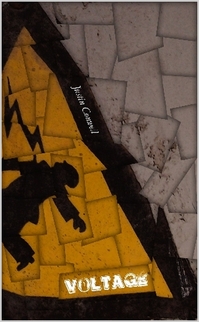
REVIEW: Voltage by Justin Conwell

Voltage.jpgPLOT

After attempting suicide, Eric had his self-destructive thoughts blasted out of his head through Electro-Convulsive Therapy. Unfortunately, the therapy also stole his memory of what drove him to suicide in the first place. Even worse, it tore away the creative part of Eric's brain, leaving the former painter without the inspiration to do much more than work as a clerk at the local discount store.

Now a year has passed, and Eric's daily routine is upended when the latest load of donations includes a box filled with ashes and labeled "Harold." Pressed into a road trip to bring Harold's remains back home, Eric finds himself forced to confront both his current life and the past that got him there.

MY TAKE

Over a year ago, I wrote a brief review of Saints Visible by "Justin Gil." I described the novel as a "charming, folksy tale" with considerable "laid back charms," although I found the resolution to be "rather abrupt" and "too easy."

I have been told that Voltage, attributed to a "Justin Conwell," is in fact the same author's second novel. Based on the evidence of the two books, I certainly believe it. Voltage demonstrates the same strengths as Saints Visible: a clear, inviting writing style that immediately draws the reader in. Voltage, however, is a considerably greater triumph, as it marries those strengths to a much more mature and involving story.

With its themes of suicide and long-buried memories, the novel may sound exceedingly glum or melodramatic. And indeed, as one might expect, Eric's buried memories do conceal a tragic story that ultimately impact his present as much as his past. However, Voltage is not a melodrama. Rather, Voltage is a tragedy, in the most positive (if not quite Grecian) sense of that word.

Like any good tragic hero, Eric is both deeply flawed -- indeed, infuriating at times -- but also deeply, recognizably human. Conwell draws us into Eric's tale slowly; although dark rumblings can be heard from the start, the early part of the book is fairly relaxed, and even whimsical. But as the story progresses, we grow to care about Eric and his traveling companions (including romantic interests both actual and potential). When Eric's failings and history inexorably surface, there is nothing flashy or over-the-top about the results; everything in Voltage feels real, and plausible. And this quiet power makes Eric's journey all the more affecting.

Indeed, by the end of the novel Eric and his friends have all learned, in one way or another, that you cannot run away from your past. This is, of course, an ancient literary theme, dating back (at least) to the aforementioned classical Greek tragedies. Yet Voltage distinguishes itself through compelling characters that make its exploration of this well-worn trope feel fresh, powerful, and, ultimately, heartrending. Saints Visible was worthwhile as a cute "feel good" book; Voltage, by contrast, is a genuine work of art.

AVAILABILITY

Voltage is available from Lulu here as either a $0.50 download or an $11.99 paperback. Saints Visible is also still available from Lulu, either as a free download or an $8.56 paperback. The author does not appear to have a website; nor am I aware of any other books he may have written, whether as Justin Gil, Justin Conwell, or some other pen-name.

BONUS RECOMMENDATION

The Sheds have made all four of their folksy rural rock albums available for free download, and I strongly recommend that you take them up on their generosity. Each is strong, but the most recent two -- The Sheds Quit Smoking and You've Got A Light -- are especially stunning. The Sheds sing about the small issues of day-to-day living, and, appropriately enough, their songs encompass the gentle humor, quiet yearning, and upbeat joys of everyday life, while also maintaining a consistent and intense melodiousness. These guys should not be missed.

Sunday, March 09, 2008

FreeBooks #8: Deadolescence by Robert Devereaux

Robert Devereaux's Deadolescence (A Tale of Love and Sacrifice) is a slippery customer. The story is set in the Demented States of America, where violence is a way of life and decent people live in threesomes (so long as the threesomes are mixed-gender; after all, same-sex threesomes are just wrong). To prepare them for the rigors of adulthood, high school seniors undergo a deadly prom night rite of passage: one couple is picked at random to be slaughtered by a designated slasher, chosen from the ranks of the high school faculty. This year, however, something has gone very wrong at Corundum High. And a lot more than one couple's blood is going to be spilled. . . .

At first, everything about Deadolescence seems too blunt. The satire is obvious: the President of the Demented States of America is a literal puppet, for goodness' sake. The violence (and there is a lot of it) is graphic, gory and extreme. So is the sex; there is stuff going on with piercings and zippers that I really don't want to think about any more. Be warned: this book is not for the squeamish.

But once I acclimated to the excess (more or less; the finale takes it up another notch and truly made me squirm), I was able to appreciate the novel's considerable strengths as well. The story as a whole is smartly paced and plotted, with an effective conclusion that thoughtfully, if gruesomely, caps all that came before. There are also tinges of subtlety and humor amidst the novel's extremes, whether in the amusing portrayal of anti-government crusaders or in the more quiet moments of genuine fear, such as when a young girl must hide in a closet while unspeakable things go on outside.

Perhaps the most surprising -- and ultimately telling -- aspect of Deadolescence is how much we come to empathize with, or at least understand, the students, teachers and parents of Corundum High. Violence and the infliction of pain are fundamental parts of life in the Demented States of America. The characters who inhabit that world, naturally enough, largely tolerate (and even endorse) the society in which they have always lived. As a result, they accept and do things that we, as readers in the United States of America, might (and hopefully do) find barbarous. Yet even if we don't always agree with their worldview, we can at least begin to understand it, given the context in which it developed. Despite our profound differences in values, we can even relate a little bit, as we wonder how we would behave if we grew up in their world.

I don't mean to make too much out of Deadolescence. It is, in essence, a slasher film in novel form. But as such things go, it is an especially fine and intelligent slasher film. It is filled with effective gore, real frights, and good characters, is thoughtful enough to have real substance, and is great fun to boot.

As of this writing, Deadolescence is available for free at the author's website. Grab it while you can; Devereaux has promised to try to bring the book to print, either from a traditional publisher or, if necessary, POD. (And I must say, in the event that you don't read this until after the novel is no longer available for free: if you can stomach extreme horror, Deadolesence is well worth paying for). For more graphic violence-and-sex fun, this time set in a world where Santa Claus and fairy tales are real, check out Devereaux's equally extreme Santa Steps Out, published by Leisure Books and available used on Amazon.

Saturday, March 08, 2008

REVIEW: Perchance to Feast by Ellen Belitsky

PerchanceToFeast(S).jpgPLOT

Sixty years ago, the cosmic imp Chance, in his eternal quest for entertainment, set a scheme in motion. He contrived to inspire Sadie and Lillian, best friends at Hometown Junior High, to write the story of Subring, a hellish realm where the mean girls who bullied them would be punished. Scared of their own creation, the girls quickly abandon the story. But dark ideas, once loosed, are not always easily buried.

Now, decades later, Chance is ready for the grand amusement to begin. A new generation of Hometown residents, including Sadie's own granddaughter, have been set in motion and are ready to assume their roles. And Subring is ready to be unlocked.

MY TAKE

I expected the worst from Perchance to Feast. The back cover description seemed to promise a twee fairy tale. Based upon my own prejudices, the author bio (Ms. Belitsky describes herself as a "retired teacher" who "is passionate about peace, the environment, the Bill of Rights and all things built of words") appeared even worse. I knew I was being unfair, but what could a retired teacher have to say to someone as jaded as me? And the first few pages -- told from Chance's point of view -- heightened my fears. They struck me as overwritten, filled with alienating alliteration and the typical "look at the superior cosmic being who happens to find amusement in playing with humans" clichés that I have seen so many times before.

And, to be honest, Perchance to Feast does lack a certain professional polish that betrays its POD origins. The (thankfully few) passages told from Chance's perspective continue to be heavy-handed. Similarly, Sadie's dialogue, filled with "Oy!"s and noun-verb inversions, is less colorful than it is a caricature (she is a Russian immigrant). And Ms. Belitsky's decision to use on-the-nose names for places and off-stage characters (the novel takes place in "Hometown," which is home to both "Hometown Junior High" and snooty "Classical Academy;" "Mr. Cleanitup" is the janitor, while "Mrs. Fuddydud" and "Mrs. Stickler" are teachers) is not so much clever as evidence that Ms. Belitsky was trying too hard.

But my reservations soon fell away, and I suddenly realized that I was truly enjoying Perchance to Feast . The novel quickly hit its stride once the POV shifted from Chance to other characters and the story began to unfold. Yes, the novel is essentially a fairy tale about a brave young girl foiling the plans of a grotesque evil queen. However, Perchance to Feast is anything but twee. The story is surprisingly dark, mature and involving. Although Subring does not open its doors until the last portion of the book, Ms. Belitsky holds our interest throughout with an interesting backstory and a slowly escalating tension, with a fully satisfying resolution.

Indeed, the many successes of Perchance to Feast easily overcome its few stylistic failings. In particular, Ms. Belitsky's handling of one of the novel's underlying themes -- how stories impact our lives -- is impressively graceful. Novels dealing with "the power of the imagination" are often uncomfortably blunt and, quite frankly, unimaginative. But Perchance to Feast handles this theme deftly. The novel may not exactly be subtle; after all, the premise of the novel is that Chance has manipulated the cosmos so that the imaginary Subring will intrude on the real world. But Ms. Belitsky's handling of this subject is elegant and low-key, allowing the theme to play out naturally and without becoming overbearing.

Ultimately, however, it is Ms. Belitsky's handling of her characters that is particularly accomplished. The more "down to earth" characters, such as Lillian (an elderly woman for most of the novel) and Sadie's grand-daughter Karma Robin (a thirteen year old who likes to be called K-Rob) all feel genuine, despite the range in their ages and personalities. The more "extreme" characters such as the villainous Hera, the drama teacher at Classical Academy, are so (entertainingly) monstrous as to be almost inhuman. Yet both types of character work well on their own and, impressively, this contrast does not tear the novel apart. Perhaps the ability of these disparate characters to co-exist is due to Ms. Belitsky's decision to keep them apart for most of the novel, until the situation is so out-of-control that the mashing of the ordinary and the extreme seems reasonable. Or perhaps it is because Ms. Belitsky succeeds in giving us just enough background detail about even the monsters so that, ultimately, they don't seem quite so inhuman after all.

AVAILABILITY

Perchance to Feast is available for $15.95 from iUniverse or Amazon. (As always, iUniverse has a free preview of several pages available.) Ms. Belitsky writes a blog about the novel called Perchance to Publish; she has written several interesting posts about the benefits and frustrations of publishing through iUniverse, including a couple that reveal how such an interesting novel ended up with such an uninspiring cover.

BONUS RECOMMENDATION

Extraordinary(s).jpgBack during the initial run of this blog, John Purlia sent me a review copy of his novel The Extraordinary Adventures of the 25 Year Old Birthday Muse (available from Lulu through a special link available on request from the author). I didn't review it at the time because I didn't know quite what to say. In large part, I still don't.
Extraordinary Adventures is an episodic fairy tale about Kathy, muse of Gardening, Fashion and Photography, who wishes on her twenty-fifth birthday to "finally find the artist whom I shall inspire." She is immediately cast from Olympus in order that she might better chase her dream. What follows is a series of agreeable encounters with quirky people and places (illustrated by full-color reproductions of masterpieces of mythologically inspired art), events that, while individually interesting, lack conflict or narrative drive. I enjoyed Extraordinary Adventures, the same way one might enjoy a languorous stroll through a local art museum on a hot afternoon: a pleasant diversion to be sure, and worthwhile in its understated charms, but, ultimately, not fully inspiring.